Lucretia (fragment)

Lucretia (fragment)

Title

Lucretia (fragment)

[cda 2023]

Painting on beech

Medium

Painting on beech

[Heydenreich, unpublished examination report, 16.10.2023]

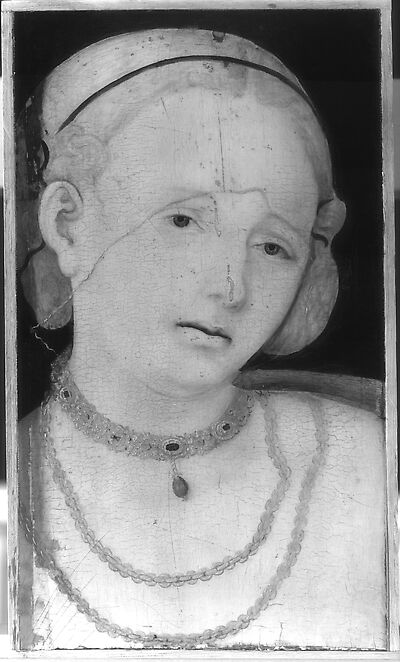
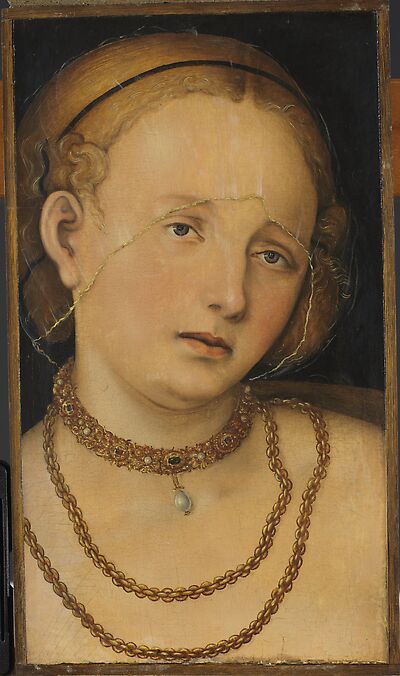
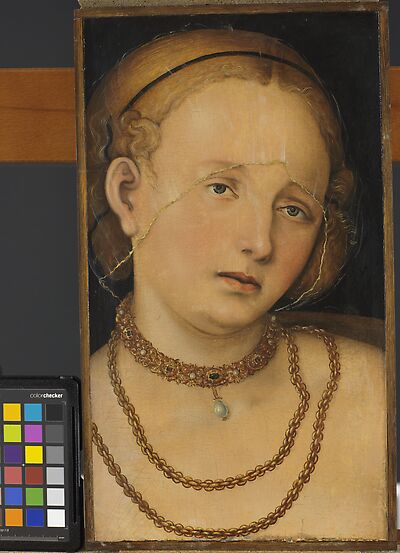
The painting depicts a female head against a dark background, wearing a dark hairband and a veil. Above her left shoulder there is a tiny segment of a brown fur garment. A band set with precious stones and a pearl decorates her neck, as well as two link chains. It

The painting depicts a female head against a dark background, wearing a dark hairband and a veil. Above her left shoulder there is a tiny segment of a brown fur garment. A band set with precious stones and a pearl decorates her neck, as well as two link chains. It was probably originally a representation of Lucretia that only survives as a fragment.

[cda 2023]

Attribution
Workshop Lucas Cranach the Elder

Attribution

Workshop Lucas Cranach the Elder

[Heydenreich, unpublished examination report, 16.10.2023]

Production date
about 1535 - 1545

Production date

about 1535 - 1545

[Heydenreich, unpublished examination report, 16.10.2023]

Dimensions
Dimensions of support: 38 x 21.8 cm (including additions)

Dimensions

  • Dimensions of support: 38 x 21.8 cm (including additions)

  • [Heydenreich, unpublished examination report, 16.10.2023]

Signature / Dating

none

Inscriptions and Labels

none - reverse of the panel: circular stamp '[...]28'

  • handwritten on the cradle: '26 RR'
    [Heydenreich, unpublished examination …

Inscriptions and Labels

Inscriptions, Badges:

  • none

Stamps, Seals, Labels:

    • reverse of the panel: circular stamp '[...]28'
    • handwritten on the cradle: '26 RR'
  • [Heydenreich, unpublished examination report, 16.10.2023]

Owner
Private Collection
Repository
Private Collection
CDA ID
PRIVATE_NONE-P621
FR (1978) Nr.
FR-none
Persistent Link
https://lucascranach.org/en/PRIVATE_NONE-P621/

Provenance

Research History / Discussion

This fragment was probably originally a depiction of Lucretia as a half-figure, like the numerous versions that have survived from Cranach's

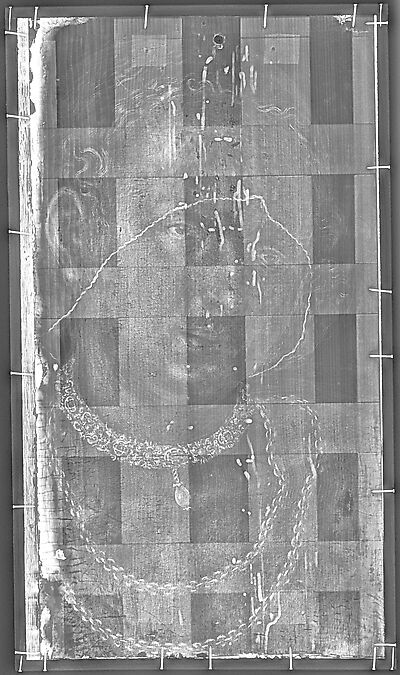
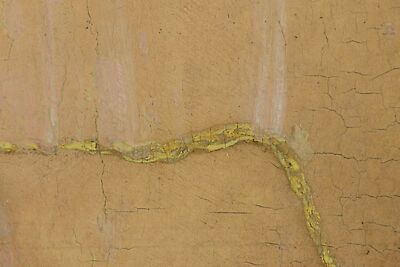
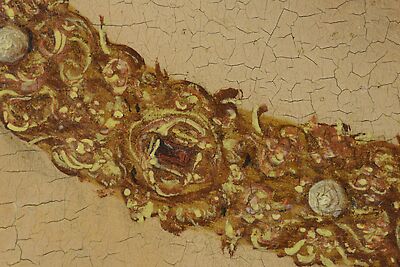
workshop. Assuming that it was one of Cranach’s standard format beech wood panels, it is possible to divine the original dimensions, approx. 83 x 59 cm (format D). On other Cranach paintings from the 1530s the underdrawing is often not visible in the IR-reflectogramm. The identified pigments were used in the Cranach workshop, as well as in other contemporary workshops. Examples of Cranach’s use of gold for the veil and the collar are not yet known. However, several works from Cranach's workshop dated in the 1530s document the use of gold in the form of shell gold used for individual pictorial elements. Compared to other works by Lucas Cranach the Elder, the gemstone settings and other decorative elements on the necklace appear to be less skilfully executed and were altered after the gold was applied (see x-radiography). It has not yet been possible to establish when the gold was applied, but the fact that it is partially covered by the lead-tin-yellow paint suggests it might have been in the Cranach workshop and that an execution before 1750 is very likely.

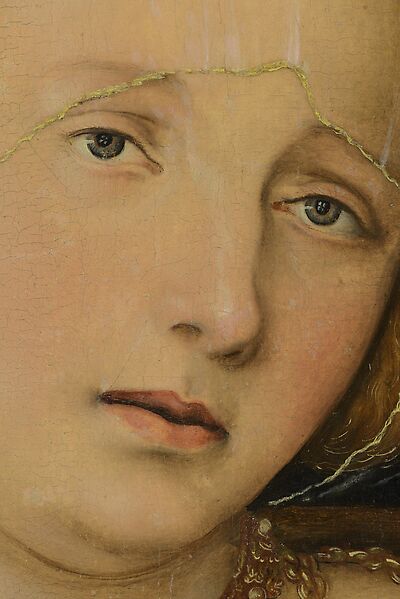
The flesh paint and hair were executed with great confidence and attention to detail. However, certain details, as well as the volume and depth appear to be less developed than in other works (e.g. in Bilbao and Hannover) attributed to Cranach the Elder. The painter of this panel was evidently familiar with the formal language, and the materials and techniques used in Cranach's workshop. These observations suggest that the fragment is from a high-quality depiction of Lucretia, which was created around 1535–45 in the Cranach workshop, probably by an assistant (workshop of Lucas Cranach the Elder), although a contribution by Lucas Cranach the Elder cannot be precluded.

[Heydenreich, unpublished examination report, 16.10.2023, translated from German]

  • Lucretia (fragment), about 1535 - 1545

Images

Compare images
  • overall
  • overall
  • reverse
  • irr
  • x_radiograph
  • detail
  • detail
  • detail
  • detail
  • detail
  • detail
  • detail
  • detail
  • detail

Technical studies

16.10.2023Technical examination / Scientific analysis

  • Stereomicroscopy
  • UV-light photography
  • Instrumental material analysis
  • Infrared reflectography
  • X-radiography

Support

The following methods of examination were employed:

Stereomicroscopy, XRF-Analyse (Thermo Scientific - Niton XL3t GOLDD+) UV-light, x-radiography (Oehm u. Rehbein, Leonardo/ Varex-Perkin Elmer XRPad2 4336), Infrared reflectography (Osiris 900 - 1700 nm)

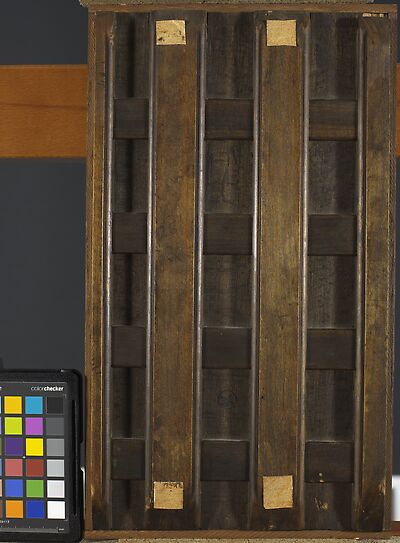
- a beech panel (fragment) consisting of a single vertically aligned board

Ground and Imprimatura

- there is a white ground application

Underdrawing

- an underdrawing is not visible in the infrared reflectogram

Paint Layers and Gilding

The following elements were detected using XRF-analysis and on the basis of their optical properties the following pigments were identified:

Yellow (veil): Ca, Pb, Fe, Sr (Sn)

Ca: chalk/ gypsum(?); Pb: lead white; Pb/ Sn: lead-tin-yellow (?); Fe: iron oxide/ ochre (?); Sr: component of chalk (?)

Blue (eye): Pb, Ca, Hg, Fe, Sr (Cu)

Pb: lead white; Ca: chalk/ gypsum (?); Hg: vermillion; Fe: iron oxide/ ochre (?); Cu: blue pigment containing copper; Sr: component of chalk (?)

White (pearl): Pb, Ca (Fe, Sr)

Pb: lead white; Ca: chalk/ gypsum (?)

Green (gem stone) Pb, Cu, Ca, Fe, Sn, Hg, Sr

Pb: lead white; Cu: green pigment containing copper; Ca: chalk/ gypsum (?); Pb/ Sn: lead tin yellow (?); Hg: vermilion; Fe: iron oxide/ ochre (?); Sr: component of chalk (?)

Yellow (necklace): Pb, Fe, Ca, Sn, Hg, Sr, (As)

Pb: lead white; Pb/ Sn: lead-tin-yellow; Fe: iron oxide/ ochre (?); Ca: chalk/ gypsum (?); Hg: vermilion; Sr: component of chalk (?); As: orpiment(?)

Yellow (veil): Pb, Ca, Sn, Au, Sr, Fe, (As)

Pb: lead white; Pb/ Sn: lead-tin-yellow; Ca: chalk/ gypsum (?); Au: gold; Sr: component of chalk (?); Fe: iron oxide/ ochre (?); As: orpiment(?)

Pigments: lead white, lead-tin-yellow, vermilion, iron oxide/ ochre, azurite, verdigris and possibly orpiment. Gold was detected in the veil.

The paint was applied in several layers with different brushes both flat and stippled. The flesh paint was laid in with a pale mixture of lead white and vermilion pigments as well as brownish-grey half shadows. These were then reinforced with semi-transparent brown glazes and highlights were applied with a lighter and at times pinker flesh paint. The white paint in the eyeballs contains small amounts of azurite. The iris is modelled with grey and brown paint. In the black pupils, the reflection of a window is indicated by four white highlights. In the left eye, these reflections were created with two vertically drawn white lines and then divided into four points with a horizontal line in black paint. The strands of hair are finely executed, using whitish-yellow paint on the flat brown underpaint. A semi-transparent veil is indicated with a thin application of white paint. The edge was initially painted white and then highlights were added in lead-tin-yellow. There is also some gold (gold leaf or shell gold). The collar was laid in with a reddish-brown paint (iron oxide). Red and green stones, pearls and decorative elements were then painted on, and some detail was added with gold. Further differentiation was carried out with lead tin yellow. The white pearl is probably original, as no evidence suggesting the contrary was found. An initial layer of yellow ochre was used to paint the chains and then they were modelled with a brownish-red paint, yellow (lead tin yellow) and black paint was used to create volume. The x-radiograph does not show any evidence of significant compositional changes during the painting process.

[Heydenreich, unpublished examination report, 16.10.2023]
Condition Reports

Date16.10.2023

The panel is a fragment of a once larger painting. The reverse was thinned to thickness of c. 5 mm. A cradle was attached to the reverse and wooden battens (c. 6 mm in width) were attached to all four sides.

At the time of examination the painting was in a stable condition.

Support:

  • thinned and cradled with some woodworm damage

  • the cradle has been cut, suggesting that the panel was first cropped after it was attached

Paint layers:

  • an extensive but very fine craquellée

  • at the left edge the image has been reconstructed (see x-radiograph)

  • slight abrasion in the areas of shadow

  • retouches, particularly in the flesh paint

[Heydenreich, unpublished examination report, 16.10.2023]
  • examined by Gunnar Heydenreich

Citing from the Cranach Digital Archive

Entry with author
<author's name>, 'Lucretia (fragment)', <title of document, data entry or image>. [<Date of document or image>], in: Cranach Digital Archive, https://lucascranach.org/en/PRIVATE_NONE-P621/ (Accessed {{dateAccessed}})
Entry with no author
'Lucretia (fragment)', <title of document, data entry or image>. [<Date of document, entry or image>], in: Cranach Digital Archive, https://lucascranach.org/en/PRIVATE_NONE-P621/ (Accessed {{dateAccessed}})

Help us to improve the Cranach Digital Archive.

Please contact us, if you have noticed a mistake.