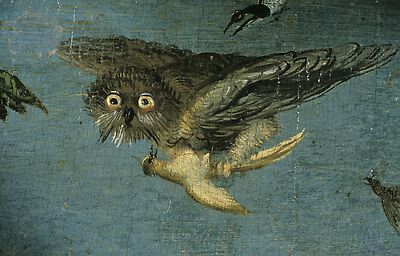
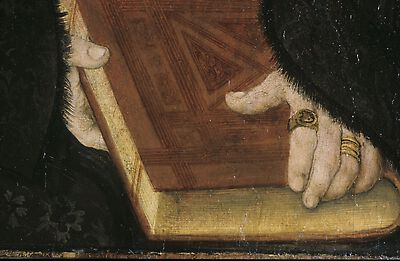
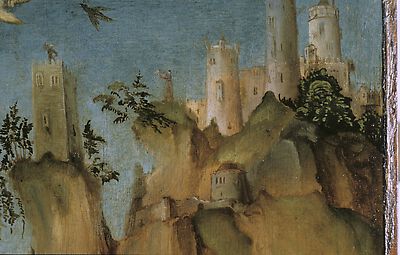
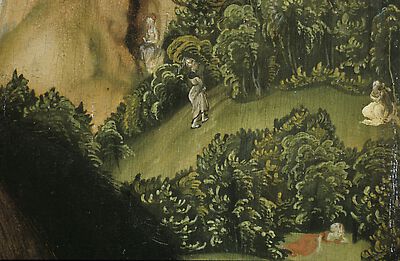
Dimensions of support: 60.3 x 45.5 x 0.45-0.55 cm (almost original size)
Dimensions
Dimensions of support: 60.3 x 45.5 x 0.45-0.55 cm (almost original size)
Signature / Dating
None
Inscriptions
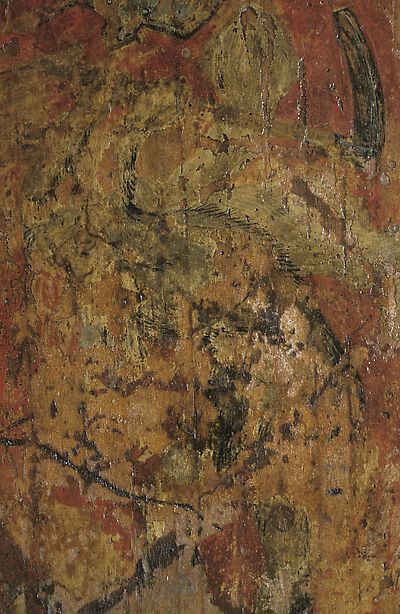
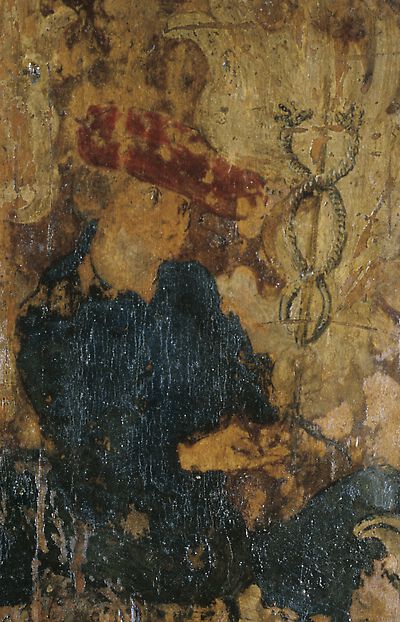
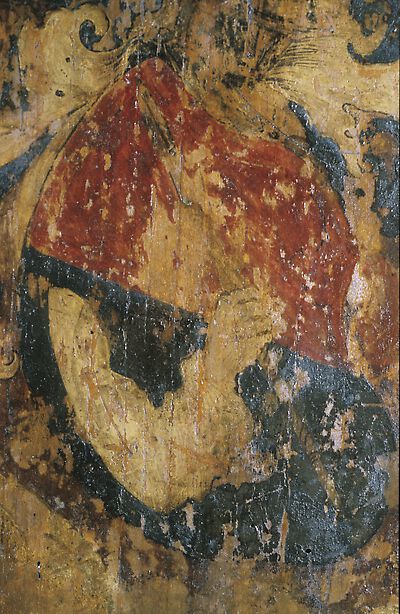
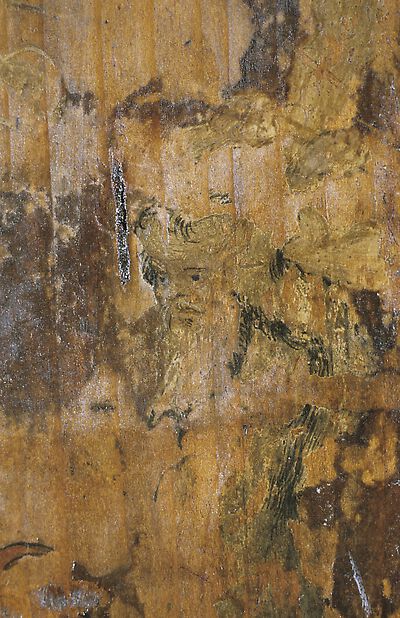
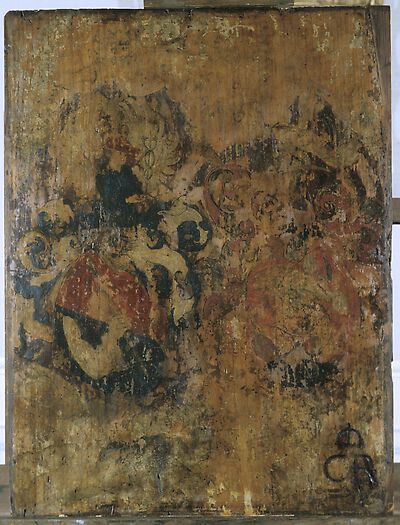
Fragmentary painted remains of the combined coat of arms of the Spiessheimer (latinized Cuspinianus) and Putsch families on the …
Inscriptions
Inscriptions:
Fragmentary painted remains of the combined coat of arms of the Spiessheimer (latinized Cuspinianus) and Putsch families on the reverse of the panel
Labels
The reverse of the panel is branded with the insignia 'CR' (Carlus Rex) on the bottom right, above which …
Labels
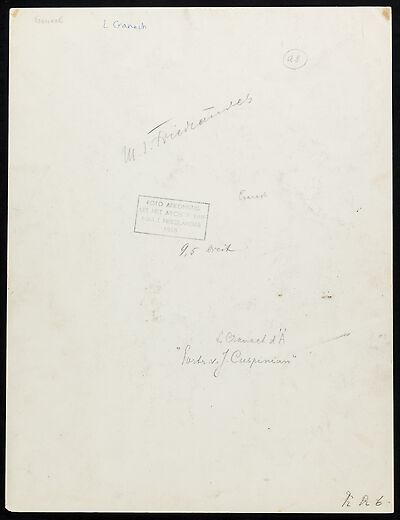
later inscription, stamps, seals, labels:
The reverse of the panel is branded with the insignia 'CR' (Carlus Rex) on the bottom right, above which there is a crown (it is identical to the markings on the reverse of the Portrait of Anna Cuspinian)
- King Charles I of England
- Locker-Lampson Family, England
- Baron of Sandys, England
- art market A. -G., Luzern, Julius Böhler gall.
- acquired by Reinhart in 1925
Dürer, Cranach, Holbein. Die Entdeckung des Menschen das deutsche Porträt um 1500 [Kunsthistorisches Museum, Vienna, 31 May 2011 - 4 Sept. 2011, Kunsthalle der Hypo-Kulturstiftung Munich, 16 Sept.-15 Jan. 2012]
Lucas Cranach a ceské zeme/ Lucas Cranach and the Czech Lands
Publication
in Kaliopi Chamonikola, ed., Pod znamením okrídleného hada. Lucas Cranach a ceské zeme, Under the winged Serpent, Lucas Cranach and the Czech Lands, Exhib. Prague 2005
Lucas Cranach. Vývesní stít staronemecké malby/ Lucas Cranach. The signboard of Old German Painting
Publication
in Kaliopi Chamonikola, ed., Pod znamením okrídleného hada. Lucas Cranach a ceské zeme, Under the winged Serpent, Lucas Cranach and the Czech Lands, Exhib. Prague 2005
Unsichtbare Meisterzeichnungen auf dem Malgrund. Cranach und seine Zeitgenossen. Ausstellungskatalog und Tagungsband Katalogteil 1; 2: Werkstatt und Schüler Cranachs; 3: Süddeutsche Meister; 4: Albrecht Dürer und sein Kreis; 5: Rheinische Meister
Herstellung, Grundierung und Rahmung der Holzbildträger in den Werkstätten Lucas Cranachs d.Ä.
Publication
in Ingo Sandner, Wartburg-Stiftung Eisenach and Fachhochschule Köln, eds., Unsichtbare Meisterzeichnungen auf dem Malgrund. Cranach und seine Zeitgenossen, Exhib. Cat. Eisenach
in Ingo Sandner, Wartburg-Stiftung Eisenach and Fachhochschule Köln, eds., Unsichtbare Meisterzeichnungen auf dem Malgrund. Cranach und seine Zeitgenossen, Exhib. Cat. Eisenach
Claus Grimm, Johannes Erichsen, Evamaria Brockhoff
Title
Lucas Cranach. Ein Maler-Unternehmer aus Franken [Festung Rosenberg, Kronach 17.05 - 21.08.1994; Museum der Bildenden Künste, Leipzig 07.09 - 06.11.1994]
Series
Veröffentlichungen zur bayerischen Geschichte und Kultur
in Peter Feist, ed., Lucas Cranach. Künstler u. GesellschaftReferate d. Colloquiums mit Internat. Beteiligung zum 500. Geburtstag Lucas Cranachs d.Ä., Staatl. Lutherhalle Wittenberg, 1. - 03.10.1972
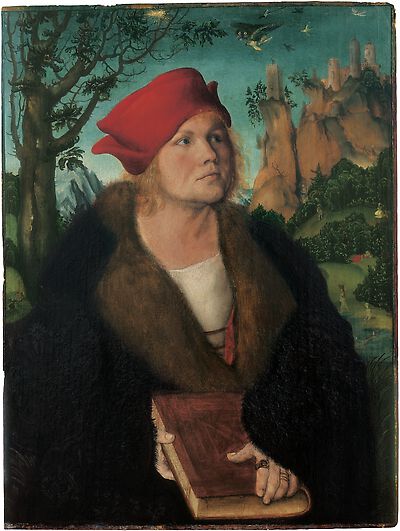
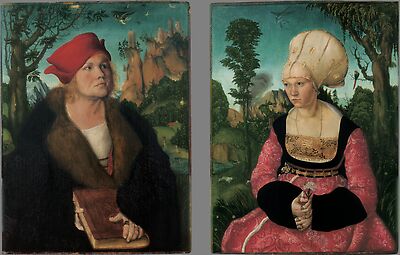
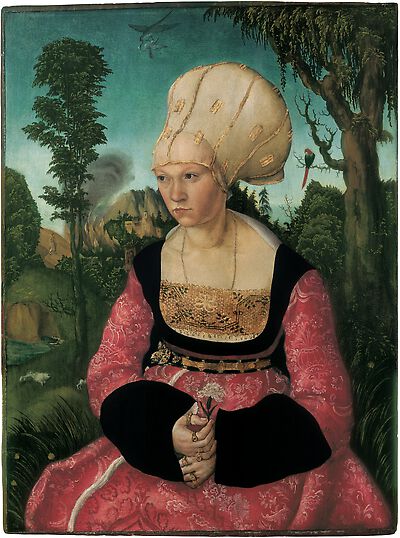
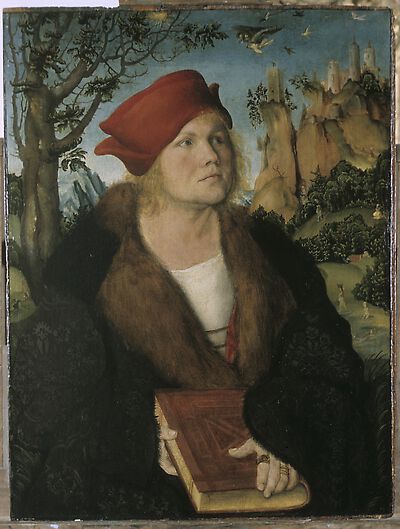
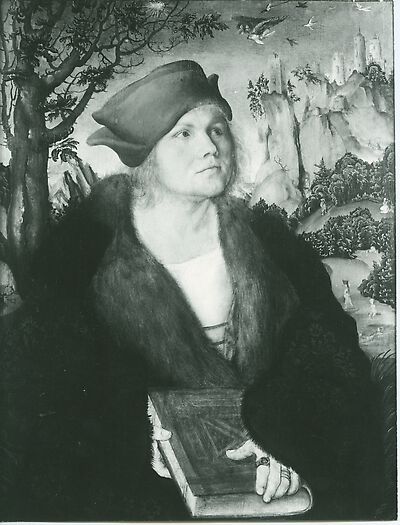
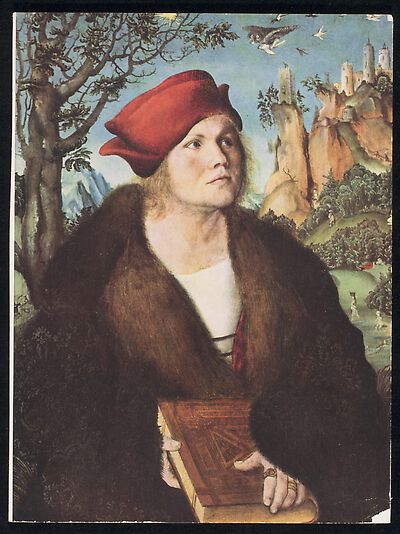
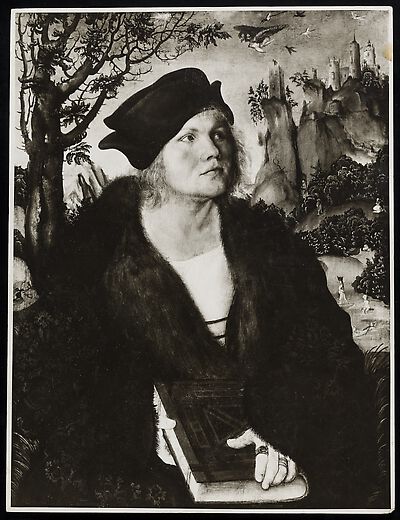
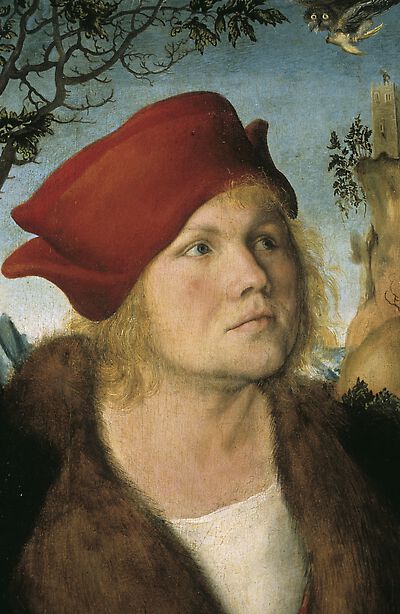
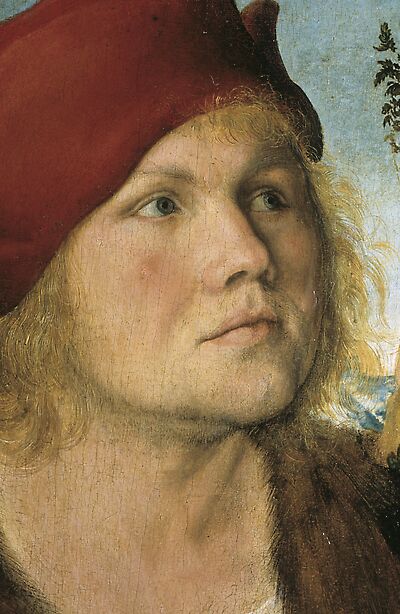
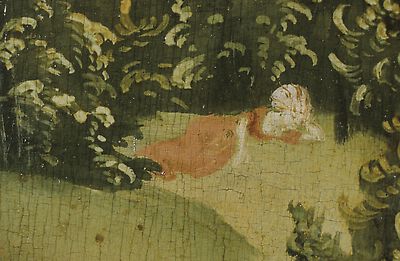
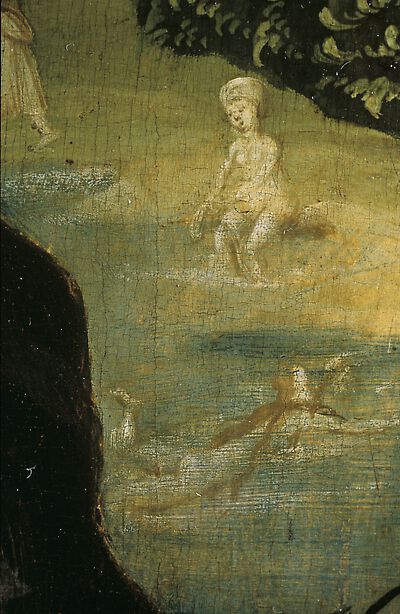
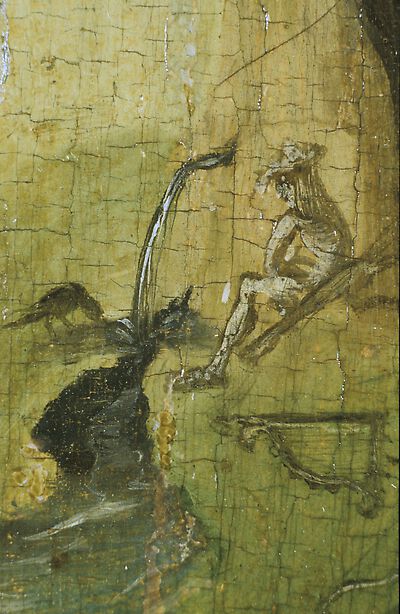
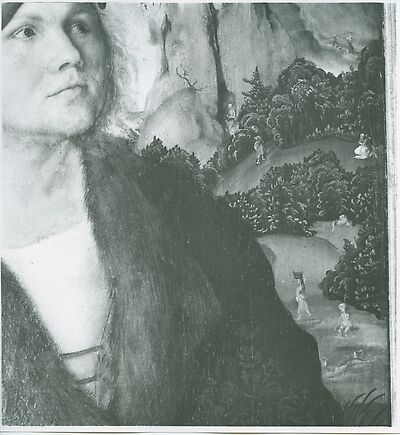
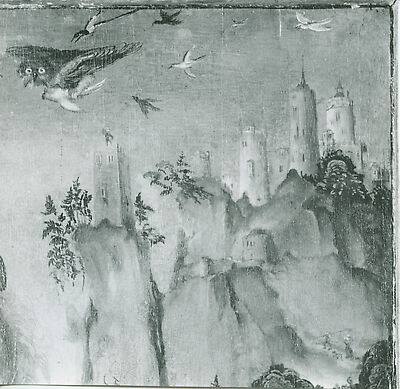
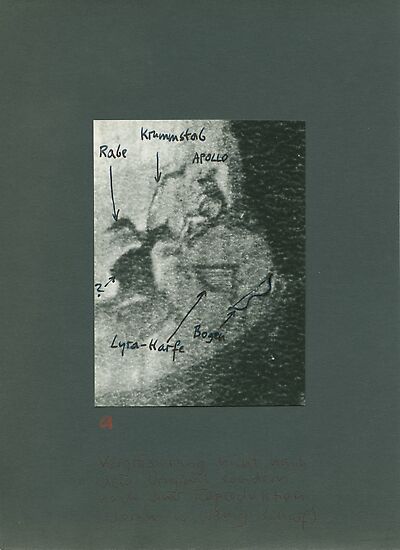
This panel and its pendant piece (Anna Cuspinian) can be considered together as a single work, which was probably commissioned as a wedding portrait. The sitter is Johannes Cuspinian, a humanist born in Franken. In 1492, attracted by the intellectual circles, he moved to Vienna. Here he met his future wife Anna Putsch, the daughter of the royal treasurer Ulrich Putsch and depicted in the pendant piece. The continuous landscape into which the sitters have been placed is only divided by the frame and thus supports the theory that both portraits were conceived as a unit. The original frame was probably hinged so that it could be closed or propped upright and did not necessarily hang on the wall. Various elements subtly convey both Christian and humanistic symbolic meaning, some alluding to love and wedlock. 'In den Worten von Ernst Buchner 'Der frühlingshafte Zauber eines neuen Weltzeitalters liegt über den Tafeln.' (In the words of Ernst Buchner 'A spring magic of a new age envelopes these panels.')
[Koepplin 2003, 133]
Description in [Friedlander, Rosenberg 1978, 66-67]; [Koepplin 1973]
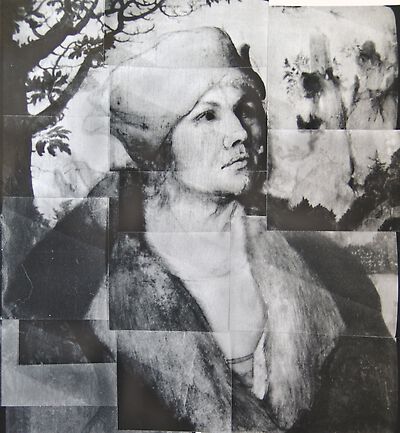
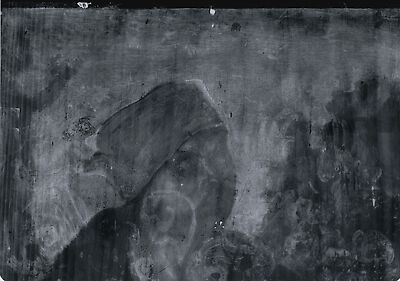
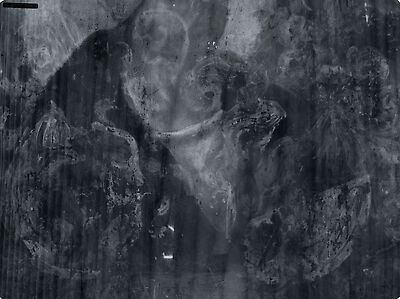
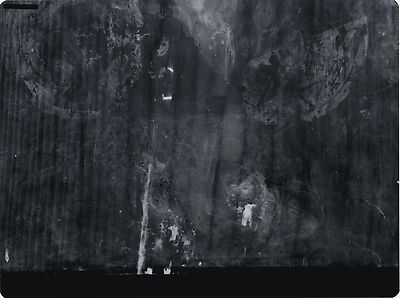
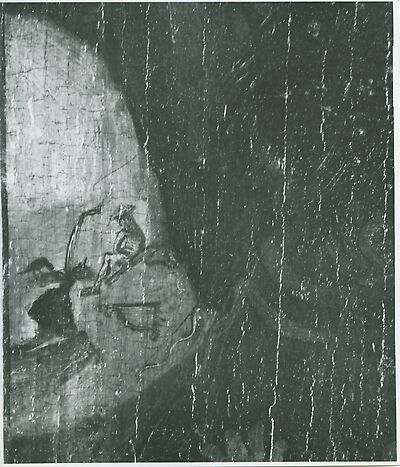
The support consists of one broad tangentially cut pinewood plank (60.3 x 45.4 cm; a ratio of c. 4:3) with the grain running vertically. A knot close to the bottom edge, left of the centre, has been preserved. It may be concluded from the rings visible in the x-radiograph that both panels of the diptych are from the same plank. The top edge of the panel depicting Anna Cuspinian can be matched with the bottom edge of the panel depicting Johannes. In the area to the left of his head attire a local application of fibres (flax tow) is visible in the x-radiography. The reverse of the panel has been smoothed with a plane. The edge of the panel has been slightly bevelled/chamfered on the reverse along all sides. The left side of the panel may have been cropped by 2-3 mm.
Ground and Imprimatura
The painting has a white ground. It appears to be a glue/chalk ground (EDX analysis of a sample from the Portrait of Anna Cuspinian showed the presence of calcium). In the x-radiograph light scratches are visible to the left of the head that may have occurred when the panel was sanded down. A burr created by the ground is present on all four sides of the panel about 0.5 cm from the edge (on the left 0.3-0.2 cm). Particles of wood are attached to the bare wood along the burr. The area to which ground was applied measures 59.1 x 44.5-44.8 cm. There are no incised lines visible along the edge. The burr is covered with a layer of black paint. There is a very thin white ground on the reverse.
A pigmented imprimatur cannot be identified.
Underdrawing
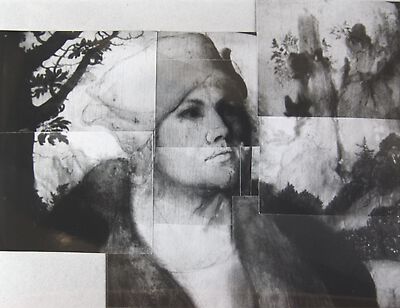
Black fluid drawing medium, probably applied with a brush. Visible with the naked eye in amongst others the area of the upper lip. Lines have partially separated into single islands of colour, possibly resulting from a water-based ink and the repellent action of an oily isolating layer.
[ Infrared reflectogram (Konrad, Berlin)]
Paint Layers and Gilding
Gilding:
The stars and rings were created with gold coloured metal leaf, which appears to be gold leaf. The rays emanating from the stars were created by applying blue pigment to the metal leaf and then extended this with yellow paint.
Paint Layers:
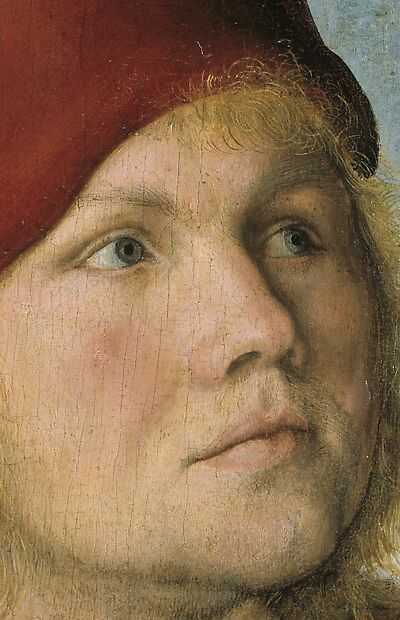
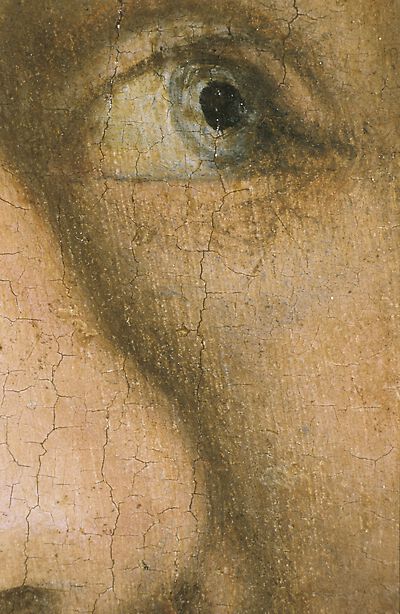
The initial layer of the flesh paint is a pinkish dead colouring. It is a rather flat application predominantly in the vertical direction. The subsequent modelling of the physiognomy was carried out with coloured glazes and lighter admixtures with lead white. While opaque mixtures of red and white were employed for the pink tones, brown tones were rather transparent. Small amounts of blue pigment were identified in the areas of shadow.
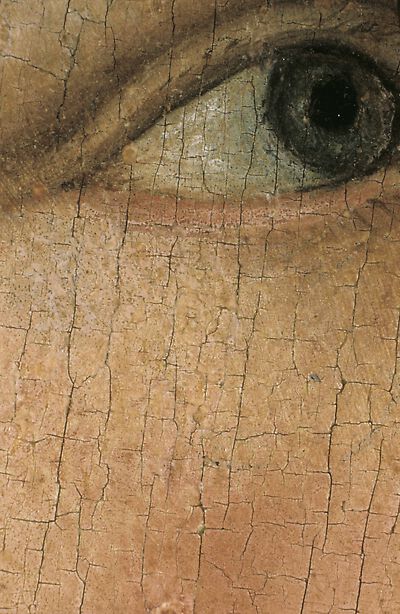
In the x-radiograph the face appears to be executed with a degree of fluidity and exhibits a relatively weak absorption profile (an apparent profile, which is created by the varying x-ray absorption subject to the pigments and the layer thickness). The forehead, cheekbone and nose are emphasized with highlights to clarify the facial features and lighting. The eyeballs are painted bluish white; the iris blue and the pupils are black without reflections. The modelling beneath the eye is reddish in tone, while the eyelid is painted in brown to black shadow. The lips are described in pink paint and a brown line separates the upper from the lower.
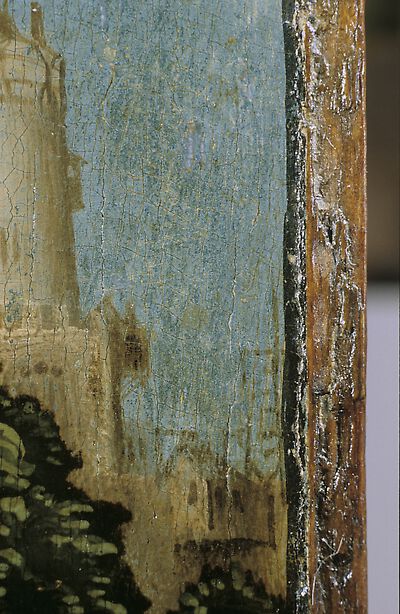
The sky was initially painted with a violet to grey admixture (identified as fluorite and lead white (EDX) in the portrait of Anna Cuspinian. This grey underpainting was lightened to white along the horizon.
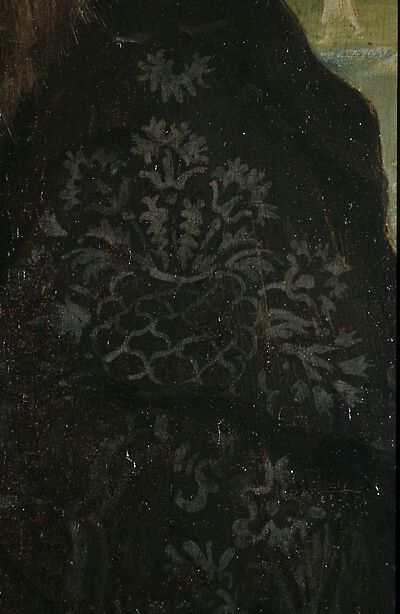
The sitter's black brocade robe contains azurite pigment particles (stereomicroscopic examination of the paint surface). In the lighter areas of the robe red lake pigments also appear to be present alongside the azurite.
The head attire seems to be underpainted in with an opaque red paint, while the subsequent modelling is carried out with a red glaze applied in various thicknesses- in part with the addition of black.
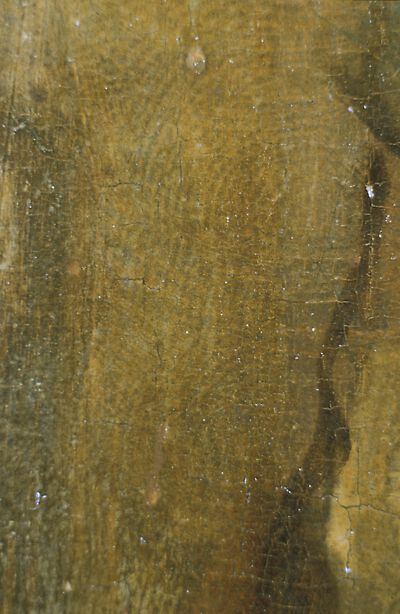
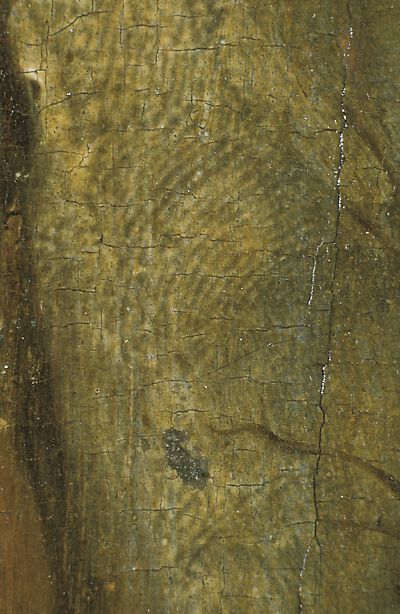
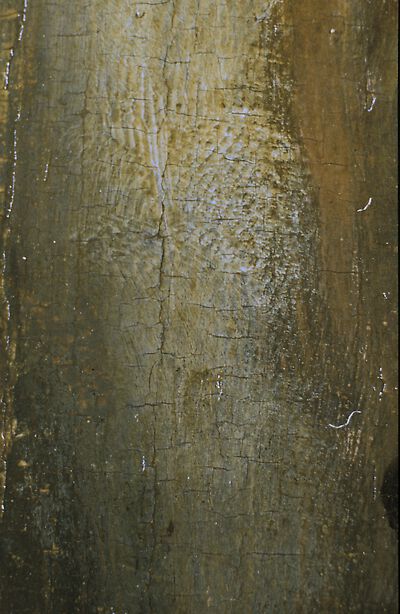
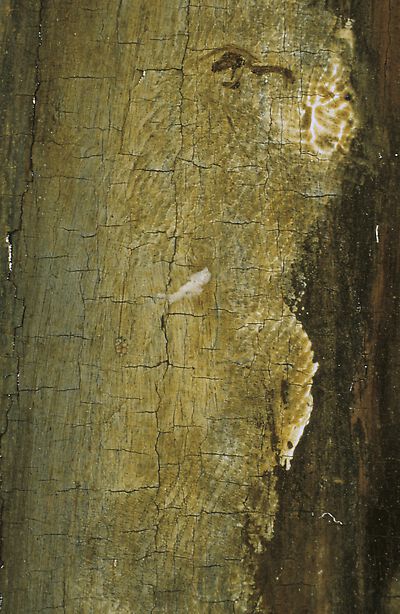
The book was under painted with bright red paint, the edge of which was removed by the application of a grey glaze. The pattern is partially scratched into the paint. It seems that Cranach pressed his finger into the wet paint to create the impression of bark on the tree trunk (background, left).
Microscopy of paint cross-section; incident light, ultraviolet light:
Sample list: 86
Cross-section number: EP 184
Brief description of paint: white paint, painting of a coat of arms
Location: Reverse, white paint
Incident Light microscopy: yes
Incident light microscopy_photo: slide
Ultraviolet light: yes
Ultraviolet light microscopy_photo: no
EDX: no
Observations:
2. very thin white layer - paint layer
1. thin white layer - ground
0. wood
Comment: white paint over a thin ground on wood
[see 06.09.1995 CA10 (Dr Gunnar Heydenreich)]
written by Gunnar Heydenreich
X-radiography
Infrared reflectography
Underdrawing
DESCRIPTION
Tools/Materials:
- fluid, black medium and brush
Type/Ductus:
- freehand underdrawing
- thin lines
Function:
- relatively binding for the final painted version; lines delineate contours and describe the essential details and the facial features; no representation of volume
Deviations:
- minor alterations made during the painting process to clearly define form
INTERPRETATION
Attribution:
- Lucas Cranach the Elder
[Smith, Sandner, Heydenreich, cda 2013]
Condition Reports
Date2003 -
Catalogue entry
"Das Bild befindet sich in einem guten Zustand. Die Holztafel ist etwas gewölbt. Inkarnat und Himmel sind etwas stark gereinigt. Einige, zum Teil verfärbte Retouchen im Himmel und im Mantel"
[Koepplin 2003, 127]
Date1995
The painting is in a stable condition. In the past the support was damaged and reconstructed along the bottom and top left edge (top c. 18.5 x 2.5 cm; below c. 7 x 1 cm). The panel is slightly warped and partially weakened by woodworm. On the bottom edge there is a crack. The paint layers are damaged in the area of the fur collar and brocade coat. There are drying cracks in the area of the head attire.
written by Gunnar Heydenreich
Conservation History
Date1969
Documentation of restoration from 1969
Dr. Paolo Cadorin, Basel
Treatment Report:
'A) Small blisters in the paint layer were reduced, particularly in the central part of the image.
B) Consolidation of the complete paint layer
C) Elimination of disturbing retouches, which had darkened.
[Archive, Oskar Reinhart Collection 'am Römerholz', Winterthur, revised 2011]
conservation treatment by Paolo Cadorin
Date1968
Documentation of restoration from 1968
W. Geissmann, Zurich
Treatment Report:
Frame: old coatings removed and replaced by new gilding
[Archive, Oskar Reinhart Collection 'am Römerholz', Winterthur, revised 2011]
conservation treatment by W Geissmann
Date1925
Paint cross-sections/Scientific examination:
Paint Layers and Gilding
Sample list: 86
Cross-section number: EP 184
Brief description of paint: white paint, painting of a coat of arms
Location: Reverse, whit paint
Incident Light microscopy: yes
Incident light microscopy_photo: slide
Ultraviolet light: yes
Ultraviolet light microscopy_photo: no
EDX: no
Observations:
1. very thin white layer - paint layer
2. thin white layer - ground
3. wood
Comment: white paint over a thin ground on wood
Documentation of restoration from c. 1925
Kinkelin, Munich
'According to the present owner the paintings were restored in Munich (by Kinkelin) shortly after their appearance on the art market. Some overpaint was removed during this intervention.'
[Koepplin 1973, 66]
conservation treatment by Kinkelin
Documentation of restoration from 19??
Paul Pfister
Treatment Report:
,Construction of two climatically controlled display cases, surface cleaning, local application of a dilute solution of dammar varnish to areas where the varnish had sunk.'
[Archive, Oskar Reinhart Collection 'am Römerholz', Winterthur, revised 2011]
conservation treatment by Paul Pfister
Citing from the Cranach Digital Archive
Entry with author
<author's name>, 'Portrait of Johannes Cuspinian', <title of document, data entry or image>. [<Date of document or image>], in: Cranach Digital Archive, https://lucascranach.org/en/CH_SORW_1925-1b/ (Accessed {{dateAccessed}})
Entry with no author
'Portrait of Johannes Cuspinian', <title of document, data entry or image>. [<Date of document, entry or image>], in: Cranach Digital Archive, https://lucascranach.org/en/CH_SORW_1925-1b/ (Accessed {{dateAccessed}})