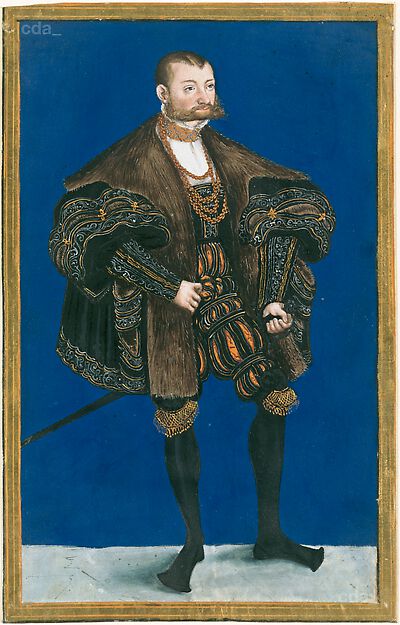
Joachim I, Prince of Anhalt-Dessau

Joachim I, Prince of Anhalt-Dessau

Painting on parchment

Medium

Painting on parchment
an llumination over a dry, black drawing material, heightened with white and gold (shell gold), binding medium applied to created partial highlights; gold frame (gold leaf); lines in orange and black; the blue background has been extensively overpainted by a later hand

[Kupferstichkabinett, Staatliche Museen zu Berlin, Stiftung Preußischer Kulturbesitz 2026]

See German version

[cda 2026]

Attribution
Lucas Cranach the Younger

Attribution

Lucas Cranach the Younger

[Kupferstichkabinett, Staatliche Museen zu Berlin, Stiftung Preußischer Kulturbesitz 2026] [Bock, Cat. Berlin 1921, 21, no. 399]

Dating
about 1542

Dating

about 1542

[Kupferstichkabinett, Staatliche Museen zu Berlin, Stiftung Preußischer Kulturbesitz 2026]

Dimensions
Dimensions of support: 263 x 167 mm

Dimensions

  • Dimensions of support: 263 x 167 mm

  • [Kupferstichkabinett, Staatliche Museen zu Berlin, Stiftung Preußischer Kulturbesitz 2026]

Signature / Dating

Artist's insignia, bottom left, probably with a brush, medium not identified: winged serpent and dated '[1]542' (oder 3)

Signature / Dating

  • Artist's insignia, bottom left, probably with a brush, medium not identified: winged serpent and dated '[1]542' (oder 3)

  • [Kupferstichkabinett, Staatliche Museen zu Berlin, Stiftung Preußischer Kulturbesitz 2026]

Labels

Verso. centre, collection stamp in black ink: Kupferstichsammlung der königlichen Museen [Lugt 1606]; bottom centre, pencil: …

Labels

later inscription, stamps, seals, labels:

  • Verso. centre, collection stamp in black ink: Kupferstichsammlung der königlichen Museen [Lugt 1606]; bottom centre, pencil: 'Z 1401 [crossed out] 399'; bottom right, pen and red-brown ink over note in pencil: 'Lucas Crana[ch] || 180'; bottom right, pencil: 'No. 136'

  • [Kupferstichkabinett, Staatliche Museen zu Berlin, Stiftung Preußischer Kulturbesitz 2026]

Owner
Kupferstichkabinett, Staatliche Museen zu Berlin, Stiftung Preußischer Kulturbesitz
Repository
Kupferstichkabinett, Staatliche Museen zu Berlin, Stiftung Preußischer Kulturbesitz
Location
Berlin
CDA ID
DE_SMBKSK_KdZ399
FR (1978) Nr.
FR-none
Persistent Link
https://lucascranach.org/en/DE_SMBKSK_KdZ399/

Literature

Reference on page Catalogue Number Figure / Plate
Cat. Berlin 1931 B 499 1054
EditorReichsdruckerei Berlin
TitleDie Reichsdrucke. Eine Sammlung von Kupferstichen, Radierungen, Holzschnitten, Gemälden, Aquarellen und Pastellen in Nachbildungen der Reichsdruckerei zu Berlin. Erster Nachtrag zum Hauptkatalog
Place of PublicationBerlin
Year of Publication1931
Degering 1928
AuthorHermann Degering
TitleZehn Bilder und Bildnisse von L. Cranach d. J. Nach Originalen im Besitz der Preussischen Staatsbibliothek und des Kupferstichkabinettes Berlin
Place of PublicationBerlin
Year of Publication1928
Cat. Berlin 1921 21 399
AuthorElfried Bock
TitleDie Zeichnungen alter Meister im Kupferstichkabinett. Die deutschen Meister. Beschreibendes Verzeichnis sämtlicher Zeichnungen, Staatliche Museen zu Berlin
Place of PublicationBerlin
Year of Publication1921
Link https://digi.ub.uni-heidelberg.de/diglit/bock1921ga
Mecheln 1814
EditorChristian von Mecheln
TitleLucas Cranachs Stammbuch, enthaltend die von ihm in Miniatur gemalte Abbildung des den Segen erteilenden Heilandes und die Bildnisse der vorzüglichsten Fürsten und Gelehrten aus Reformationsgeschichte
Place of PublicationBerlin
Year of Publication1814
Link https://mdz-nbn-resolving.de/details:bsb11708099
  • Joachim I, Prince of Anhalt-Dessau, about 1542

Images

Compare images
  • overall

Download illustration

Technical studies

2026Technical examination / Scientific analysis

Support

on parchment

Process, Medium

The portrait miniature was executed on the roughened flesh side of a parchment sheet which was designed to illustrate a manuscript. Infrared reflectography (IRR) reveals an initial outline in a dry, black drawing material, particularly evident in the face and feet.

X-ray fluorescence analysis (XRF) detected the elements gold (Au), iron (Fe) and titanium (Ti) in the border (M1), which were interpreted as iron oxide, possibly a component of a bole layer beneath the gold leaf. Calcium (Ca) was also detected and may either originate from the gesso, in which case it is chalk, or be residual calcium that remain in the skin from the liming process used to make the parchment. Copper (Cu) is associated with the blue pigment and could indicate azurite. The element mercury (Hg) may indicate vermillion. Analysis of the blue background (M2) detected copper (Cu), calcium (Ca) and iron (Fe): copper indicates the presence of the blue pigment azurite, calcium can probably be associated with the liming process, and iron may be from the extensive retouching of the blue background with Prussian blue (see below). In the flesh paint (M3), calcium (Ca) is from the liming process, lead (Pb) indicates lead white, mercury (Hg) is vermillion and iron (Fe) could be iron oxide. In the slitted robe (M4), lead (Pb) was detected and interpreted as red lead, possibly with some lead white, calcium (Ca) – from the parchment – and iron (Fe) – probably iron oxide.

The extensive overpainting of the blue azurite background was presumably intended to compensate for severe abrasion, like that found on the other pages of the so-called family album (Stammbuch), most notably on the portrait of Justus Jonas (KdZ 1746). Since the overpainting is already mentioned in Bock’s (1921) catalogue of the German drawings in the Kupferstichkabinett, the intervention must have occurred well before then. In the UV false-colour image (UVFC-365nm) some areas along the contours appear bright green. These were presumably left unpainted to preserve details that extended over the background: the beard, the fur trim fringe (along the right-hand contour of the body), and the gold embroidery around both knees. The rest of the background was extensively overpainted using a stencil to protect the figure, but Cranach’s signature and the date in the bottom left corner were not spared. Infrared reflectography (IRR) reveals a faint winged serpent here with the numbers [1] 5 4 [2?] beneath.

[Georg Josef Dietz, including the results of the infrared examination and analysis by Gunnar Heydenreich and Sarah Critchley, as well as the results from a joint investigation with Mailena Mallach, Luise Maul and Dominika Ropers (née Wojciechowska), March 2026]

25.07.2025Scientific analysis

  • Instrumental material analysis

X-ray fluorescence (XRF) (Thermo Scientific - Niton XL3t GOLDD+)

The following elements were detected using XRF and in conjunction with their optical characteristics the following fillers, drawing media and colourants could be identified:

M1 Gold (border): Ca, Fe, Ti, Au, Cu, (Hg)

Ca: chalk/gypsum (?); Fe/Ti: iron oxide (?); Au: gold; Cu: copper-based blue pigment (azurite); Hg: vermillion

M2 Blue (background): Cu, Ca, Fe

Cu: copper-based blue pigment (azurite); Ca: chalk/gypsum (?); Fe: iron oxide (?)

M3 Flesh paint: Ca, Pb, Hg, Fe,

Ca: chalk/gypsum (?); Pb: lead white; Hg: vermillion; Fe: iron oxide (?)

M4 Red (robe): Pb, Ca, Fe,

Pb: red lead / lead white (?); Ca: chalk / gypsum (?); Fe: iron oxide (?)

[Gunnar Heydenreich, Sarah Critchley, unpublished analysis report, 25.07.2025]

  • examined by Gunnar Heydenreich
  • examined by Sarah Critchley

Citing from the Cranach Digital Archive

Entry with author
<author's name>, 'Joachim I, Prince of Anhalt-Dessau', <title of document, data entry or image>. [<Date of document or image>], in: Cranach Digital Archive, https://lucascranach.org/en/DE_SMBKSK_KdZ399/ (Accessed {{dateAccessed}})
Entry with no author
'Joachim I, Prince of Anhalt-Dessau', <title of document, data entry or image>. [<Date of document, entry or image>], in: Cranach Digital Archive, https://lucascranach.org/en/DE_SMBKSK_KdZ399/ (Accessed {{dateAccessed}})

Help us to improve the Cranach Digital Archive.

Please contact us, if you have noticed a mistake.