Support
Paper type: laid
Chain lines, orientation to image: -
Chain lines (intervals): not identifiable
Laid lines (density): not identifiable
Mould side: not identifiable
Formation: not identifiable
Paper defects: not identifiable
Shadow lines: not identifiable
Mould defects: not identifiable
[Kupferstichkabinett, Staatliche Museen zu Berlin, Stiftung Preußischer Kulturbesitz 2026]
Process, Medium
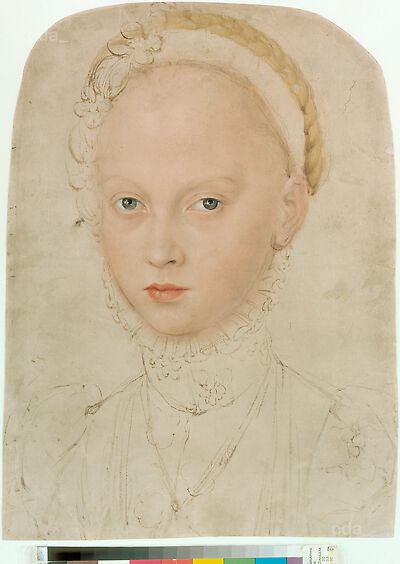
The portrait study is executed in oil paint on paper with an oil-based primer. X-ray fluorescence analysis (XRF) detected lead (Pb) in the ground (M4). This suggests the use of lead white and simultaneously identifies the red-orange pigment responsible for the ground’s slight pinkish hue as red lead. The loose sketch in a dry, black drawing material (M7) revealed no elements other than lead (Pb) from the ground. It remains unclear whether the drawing material is an organic black, such as charcoal, or a manufactured black chalk containing lamp black. If it were natural black chalk (a carbon-based aluminium silicate), it is possible that the X-ray fluorescence technique used was not sensitive enough (specifically, the measurement spot may have been too large, and it is difficult to detect light elements, such as aluminium and silicon, in small quantities).
Lead (Pb) and mercury (Hg) were detected in the red lips (M1) with white highlights, indicating the use of lead white and vermillion. The same pigments were identified in the flesh tones of the lower right cheek (M2). In the right eye (M5), lead (Pb), copper (Cu), and mercury (Hg) were measured, pointing to a combination of lead white, azurite, and vermillion. The blonde hair (M6) revealed lead and iron, suggesting a mixture of lead white and ochre. Conversely, the clothing (M3)—quickly sketched in brown with a brush—yielded no elements other than lead (Pb) from the ground, indicating the likely presence of an organic brown pigment.
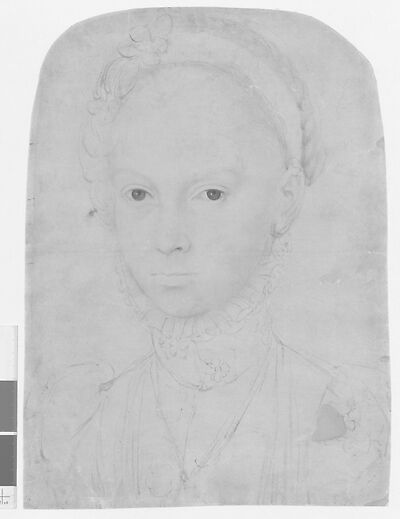
In the infrared reflectogram (IRR), the initial sketch—loosely drawn with a black, carbon-based material—becomes more distinct. On the right shoulder, the colour-matched retouching from 1993/1994 of an old loss now appears darker.
[Georg Josef Dietz, drawing on results from infrared reflectography by Gunnar Heydenreich, as well as a joint study with Mailena Mallach, Luise Maul and Dominika Ropers (née Wojciechowska), March 2026]