- Attribution
- Copy after Lucas Cranach the Elder
Attribution
| Copy after Lucas Cranach the Elder | [Cat. New York 2013, 90, No. 20] |
- Dating
- 1580 - 1620
Dating
| 1580 - 1620 | [Cat. New York 2013, 90, No. 20] |
- Dimensions
- Dimensions of support: 36.2 × 25.1 × 0.8 cm (14 1/4 × 9 7/8 × 5/16 in.)
Dimensions
Dimensions of support: 36.2 × 25.1 × 0.8 cm (14 1/4 × 9 7/8 × 5/16 in.)
(thickness beveled to 0.32 cm (1/8 in.) on edges of verso)
[Cat. New York 2013, 90, No. 20]
- Signature / Dating
Signed and dated by copyist, at left, on tree trunk [Cranach's winged serpent insignia with elevated wings and dated '1530']
Signature / Dating
Signed and dated by copyist, at left, on tree trunk [Cranach's winged serpent insignia with elevated wings and dated '1530']
[Cat. New York 2013, 90, No. 20]
- Inscriptions
- in text field, at upper left:
'dvm pver alveolo fvratvr mella cvpido, / fvranti digitvm sedvla pvnxit apis. …Inscriptions
Inscriptions:
- in text field, at upper left:
'dvm pver alveolo fvratvr mella cvpido, / fvranti digitvm sedvla pvnxit apis. / sic etiam nobis brevis et moritvra volvptas / qvam petimvs tristi mixta dolore nocet'
(As Cupid was stealing honey from the hive / A bee stung the thief on the finger / And so do we seek transitory and dangerous pleasures / That are mixed with sadness and bring us pain)
[Cat. New York 2013, 90, No. 20]
- Labels
Reverse of the panel: - on label, in Cyrillic, ts. f. t[. . .]z / ***; in round …
Labels
later inscription, stamps, seals, labels:
Reverse of the panel: - on label, in Cyrillic, ts. f. t[. . .]z / ***; in round stamp [. . .] kunst / 24.vii.28
[Cat. New York 2013, 90, No. 20]
- Owner
- The Metropolitan Museum of Art, New York
- Repository
- The Metropolitan Museum of Art, New York
- Location
- New York
- CDA ID
- US_MMANY_1975-1-135
- FR (1978) Nr.
- FR-none
- Persistent Link
- https://lucascranach.org/en/US_MMANY_1975-1-135/
Provenance
- Paul Gustav Victor von Transehe-Roseneck (d. 1928), Neu-Schwanenburg / Jaungulbene, Riga, and Berlin (by 1909) [1]
-[Zacharias M. Hackenbroch, Frankfurt, 1928] [2]
- Mrs. Albert E. (Sophie Lauer) Goodhart, NewYork (by 1934 - d. 1952)[3]
- bequeathed to Lehman
- Robert Lehman, New York (until d. 1969)
- given to the Robert Lehman Foundation on his death and transferred to MMA in 1975)
- Robert Lehman Collection, 1975[1] Neumann 1909, pp. 19 - 21, no. 26. See also letter from Mrs. Albert E. Goodhart to Ethelwyn Manning, Frick Art Reference Library, dated New York, December 20, 1934 (Frick Art Reference Library Central Correspondence, Private Collections, New York City; The Frick Collection / Frick Art Reference Library Archives); Upeniece 2005.
[2] According to Friedländer and J. Rosenberg 1932, pp. 67 - 68, no. 204e.
[3] See letter cited in note 1 above; see also Duveen Brothers, Items removed from the apartment of the late Mrs. A. E. Goodhart, dated September 19, 1952 (Duveen Brothers Records, box 157, folder 1, Special Collections and Visual Resources, Research Library, Getty Research Institute for the History of Art and the Humanities, Los Angeles).[Cat. New York 2013, 90, No. 20]
Exhibitions
Paris 1957, No. 9
Cincinnati 1959, No. 120, ill.
New York 1960, No. 15
Cologne, Antwerp 2000 - 2001, No. 25, ill.
Munich 2001, No. 11, ill.Literature
Reference on page Catalogue Number Figure / Plate Cat. New York 2013 90-93 No. 20 Author Maryan W. Ainsworth, Joshua P. Waterman Title German Paintings in The Metropolitan Museum of Art, 1350 - 1600 Place of Publication New York Year of Publication 2013 Heydenreich 2010 A 75 67g Author Gunnar Heydenreich Title Reisende Bilder im Wandel Publication in Guido Messling, ed., Die Welt des Lucas Cranach. Ein Künstler im Zeitalter von Dürer, Tizian und Metsys, Exhib. Cat. Brussels Place of Publication Brussels Year of Publication 2010 Pages 66-79 Evans 2007 58 Author Mark Evans Title "Die Italiener, sonst so ruhmsüchtig, bieten Dir die Hand": Lucas Cranach und die Kunst des Humanismus Publication in Bodo Brinkmann, ed., Cranach der Ältere, Exhib. Cat. Frankfurt Place of Publication Ostfildern Year of Publication 2007 Pages 49-61 Pérez d'Ors 2007 86, Fn. 1 Author Pablo Pérez d'Ors Title A Lutheran Idyll. Lucas Cranach the Elder's Cupid Complaining to Venus Journal Renaissance Studies Issue 21/1 Year of Publication 2007 Pages 85-98 Upeniece 2005 17 Author Daiga Upeniece Title Paul von Transehe-Roseneck und die Geschichte seiner Privatkollektion Publication in Ingrida Raudsepa, ed., Paula fon Tranzé-Rozeneka kolekcija/Sammlung Paul von Transehe-Roseneck Place of Publication Riga Year of Publication 2005 Kolind Poulsen 2003 141, Fn. 11 Author Hanne Kolind Poulsen Title Fläche, Blick und Erinnerung. Cranachs Venus und Cupido als Honigdieb im Licht der Bildtheologie Luthers Publication in Heinz Spielmann, Werner Schade, eds., Lucas Cranach. Glaube, Mythologie und Moderne, Exhib. Cat. Hamburg 2003 Place of Publication Ostfildern-Ruit Year of Publication 2003 Pages 130-143 Cat. New York 1998 43-47 No. 9 Fig. Author Charles Sterling, Maryan W. Ainsworth, Charles Talbot, Martha Wolff, Egbert Haverkamp-Begemann, Jonathan Brown, John Hayes Title The Robert Lehman Collection. Fifteenth to eighteenth century European Painting: France, Central Europe, The Netherlands, Italy and Great Britain Volume 2 Place of Publication New York Year of Publication 1998 Damisch 1996 177 Fig. 51 Author Hubert Damisch Title The Judgement of Paris Translated by John Goodman Place of Publication Chicago Year of Publication 1996 Cat. New York 1995 220 Fig. Author Katharine Baetjer Title European Paintings in the Metropolitan Museum of Art by Artists Born before 1865. A Summary Catalogue Place of Publication New York Year of Publication 1995 Exhib. Cat. Stockholm 1988 133-135 Fig. 29 Editor Nationalmuseum, Stockholm Title Cranach och den tyska renässancen Place of Publication Stockholm Year of Publication 1988 Cat. New York 1980 36 (Vol. 1) Fig. p. 296 (Vol. 2) Author Katharine Baetjer Editor The Metropolitan Museum of Art, New York Title European paintings in the Metropolitan Museum of Art Volume 1-3 Place of Publication New York Year of Publication 1980 Hutton 1980 131 Fig. 113 Author James Hutton Title Cupid and the Bee Publication in Rita Guerlac, James Hutton, eds., Essays on Renaissance Poetry Place of Publication Ithaca Year of Publication 1980 Pages 106-131 Eberle 1979 21, Fn. 1 No. 3 Author Mark W. Eberle Title Lucas Cranach's Cupid as Honey Thief Paintings. Allegories of Syphilis? Journal Comitarus: A Journal of Medieval and Renaissance Studies Issue 10 Year of Publication 1979 Pages 21-30 Szabó 1975 90 Plate 71 Author George Szabó Title The Robert Lehman Collection. A Guide Place of Publication New York Year of Publication 1975 Exhib. Cat. Basel 1974/1976 787, Fn. 1 (Bd. 2) Fig. 361 Author Dieter Koepplin, Tilman Falk Title Lukas Cranach. Gemälde, Zeichnungen und Druckgraphik Volume 1, 2 Place of Publication Basel, Stuttgart Year of Publication 1974 Link http://nbn-resolving.de/urn:nbn:de:bsz:16-diglit-104522 Russoli 1962 Plate 163 Author Franco Russoli Title Renaissance Painting Translated by Angus Malcolm Place of Publication New York Year of Publication 1962 Descargues 1961 59 Author Pierre Descargues Title Cranach Place of Publication New York Year of Publication 1961 Campbell 1957 29 Fig. Author Vivian Campbell Title La collection Lehman Journal L'Oeil Issue no. 30 (June 1957) Year of Publication 1957 Friedländer, Rosenberg 1932 67-68 204e Author Max J. Friedländer, Jakob Rosenberg Title Die Gemälde von Lucas Cranach Place of Publication Berlin Year of Publication 1932 Link http://digi.ub.uni-heidelberg.de/diglit/friedlaender1932 Cat. Riga 1909 19-21 No. 26 Fig. Author Wilhelm Neumann Title Verzeichnis der Gemäldesammlung v. Transéne, Neu-Schwanburg, Riga Place of Publication Riga Year of Publication 1909 Research History / Discussion
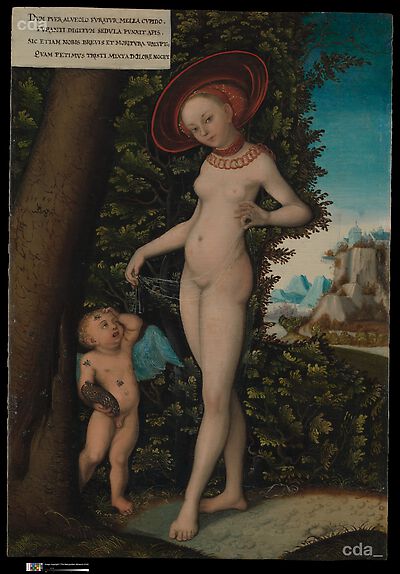
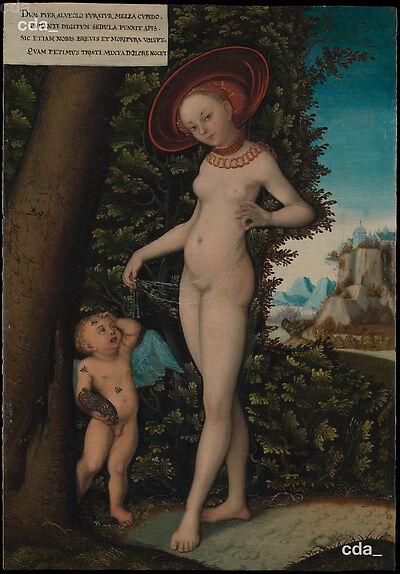
Lucas Cranach the Elder began painting depictions of Venus with Cupid taking honey from a beehive in the mid-1520s.[1] To judge from the numerous surviving variants, the theme was one of the most successful products of that artist’s workshop.[2] The subject is based ultimately on the nineteenth idyll of Theocritus, which tells of Cupid being stung by bees, whose hive he raided in search of honey, and then complaining to Venus of the great pain inflicted by such small creatures. Venus, amused, likened Cupid to the bees, remarking that he, too, is small and, as the god of love, also a bringer of great pain.[3] The Latin quatrain that appears in Cranach’s paintings is an adaptation of Theocritus’s verses by the poet Georg Sabinus.[4]
During the 1520s — concurrent with the appearance of this subject in Cranach’s oeuvre — Sabinus studied ancient Greek literature at the University of Wittenberg under Philipp Melanchthon. It is thought that Melanchthon, as a friend of Cranach, may have brought Sabinus’s verses to the artist’s attention and advised him on the subject matter.[5] While the first half of Sabinus’s quatrain summarizes the narrative passed down from Theocritus, “As Cupid was stealing honey from the hive, / a bee stung the thief on the finger,”[6] the second half delivers a forthright admonition: “And so do we seek transitory and dangerous pleasures, / that are mixed with sadness and bring us pain.” The warning clearly concerns the sexual and, more broadly, worldly temptations embodied by the nude figure of Venus, who in many versions of the subject allures the viewer with a direct gaze, making those pictures at once visually seductive and morally deterrent. The subject represents an adaptation of the moralizing theme introduced in Cranach’s first Venus and Cupid painting, the 1509 picture now in the State Hermitage Museum, Saint Petersburg, in which the goddess subdues her son, who is in the process of drawing his bow, and an inscription warns the viewer to “Avoid Cupid’s lust with all your might, that your breast not be possessed by Venus.”[7]
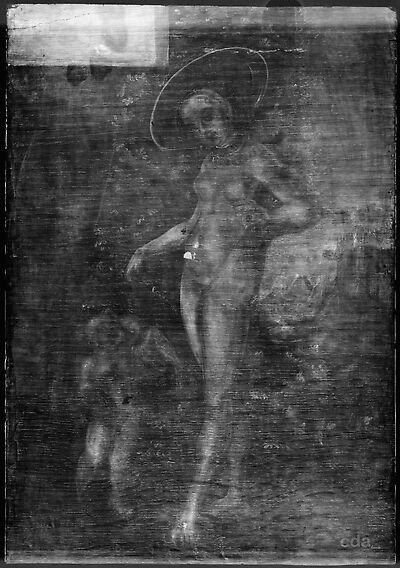
Although in the 1998 catalogue of the Lehman Collection in the Metropolitan Museum the present work was attributed to Cranach and his workshop and dated 1530 according to the inscription on the tree trunk,[8] closer technical scrutiny has shown that it is in fact an old copy after a lost original, as was already maintained by Dieter Koepplin in 1976.[9] Dendrochronological analysis of the oak support, which is original to the work, indicated an earliest possible fabrication date of 1570 and a plausible one of 1580 or later for the painting.[10] In addition, the technique used to depict the flesh is unlike that normally encountered in works of the Cranach studio, either under Lucas the Elder (d. 1553) or his son Lucas Cranach the Younger (d. 1586). Whereas in Cranach paintings the flesh is usually built up with thin translucent glazes of grays, browns, pinks, and whites over a light base flesh tone (with greater emphasis on pink and red glazes in the second half of the century under Lucas the Younger), in the Museum’s picture the flesh modeling is uncharacteristically thick, pasty, and opaque, relying heavily on a palette of mixed browns.[11]
Furthermore, the application of paint throughout the present work is broader and more summary than the precise execution characteristic of Cranach and his workshop. This is immediately apparent, for example, in Cupid’s ear and right hand, Venus’s face, and the hastily sketched-in city at the right. Comparison with a fine autograph version of the subject, such as the example dated 1529 in a private collection,[12] clearly demonstrates the considerable distance of the Museum’s painting from Cranach’s handling and execution.
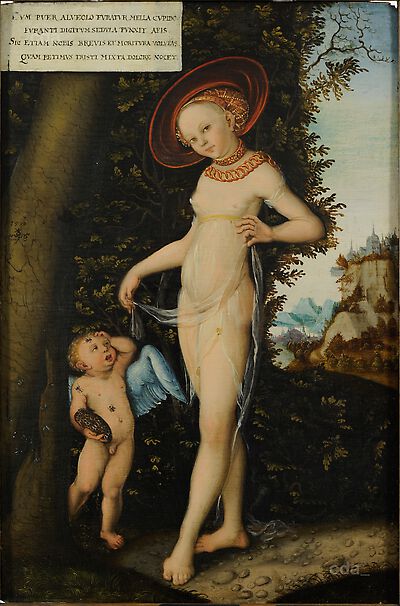
A nearly identical version of the composition, formerly in the Björnstjerna Collection, Stockholm, is likewise marked with the winged serpent insignia and a date of 1530, but also shows evidence of having been painted considerably later.[13] Koepplin suspected it, too, of being an old copy after a lost original.[14] It exhibits a similarly summary handling of the anatomical details, the foliage, and the background landscape and buildings. The diaphanous shift that has been added to Venus is of a type frequently encountered in the decades around 1600.[15] Like the Museum’s picture, the ex-Björnstjerna version is on oak, with the wood grain running horizontally,counter to the longer dimension. This is an uncommon feature, since a panel’s grain is normally oriented parallel to the longer dimension. Dendrochronological analysis of the panel of that picture indicated a felling date between 1607 and 1637 for the tree from which it was made.[16] The similar paint handling and the two instances of oak with an atypical grain orientation raise the possibility that the Museum’s and the ex-Björnstjerna versions were painted by the same hand — the same copyist working from a lost original — sometime after 1607.[17] The somewhat earlier dendrochronological dating of the Metropolitan’s panel, which establishes only a terminus post quem,does not exclude the possibility.
An enduring interest in the present composition is furthermore documented by the existence of yet another copy, probably of the later seventeenth or eighteenth century, whose current location is unknown.[18] In addition, in 1957 Pablo Picasso made a gouache painting after a magazine illustration of the Lehman panel.[19]
[1] The present discussion serves as an addendum to the entry by Charles Talbot in the 1998 catalogue of the Robert Lehman Collection (Sterling et al. 1998, pp. 43 – 47, no. 9). It offers bibliographical updates and a new assessment of the attribution and dating.
[2]See the listing of known variants in Herrmann Fiore 2010, pp. 111 – 12. The earliest surviving example, now in the National Gallery, London, dates about 1526; see Friedländer and J. Rosenberg 1978, p. 119, no. 246L; Caroline Campbell in London 2007, pp. 80 – 83, no. 2, ill. For broader considerations of the subject, see Dieter Koepplin in Basel 1974, vol. 2, pp. 655 – 56, under no. 569; Koepplin 2003b, pp. 37 – 51; Pérez d’Ors 2007, pp. 85 – 88; Herrmann Fiore 2010, all with references to earlier literature.
[3] Theocritus 1952 (ed.), vol. 1, p. 147: “A cruel bee once stung the thievish Love-god as he was stealing honey from the hives, and pricked all his finger-tips. And he was hurt, and blew upon his hand, and stamped and danced. And to Aphrodite he showed the wound, and made complaint that so small a creature as a bee should deal so cruel a wound. And his mother answered laughing, ‘Art not thou like the bees, that art so small yet dealest wounds so cruel?’”
[4] For Sabinus’s authorship, see Bath 1989, pp. 66 – 69 (based on Hutton 1941, p. 1041, n. 16; Hutton 1980, p. 112, n. 16), and the emendations of Pérez d’Ors 2007, pp. 87 – 88, 91 – 95. The quatrain was published in Sabinus’s Poemata (Strasbourg, 1538), fol. L6v (and later editions). As Charles Talbot noted in Sterling et al. 1998, p. 44, the inscription on the Museum’s painting contains the textual variants “sedvla pvnxit” and “moritvra” in place, respectively, of the usual “cvspide fixit” and “peritvra.”
[5] See Bath 1989, pp. 68 – 69; Pérez d’Ors 2007, pp. 87 – 88. Koepplin 2003b, pp. 37 – 38, has proposed both Melanchthon and the electoral Saxon secretary and court historiographer Georg Spalatin as likely iconographical advisers.
[6] These first two lines Sabinus borrowed and modified from Ercole Strozzi’s Theocritus translation published in 1513 (see Leeman 1984, p. 275).
[7] Friedländer and J. Rosenberg 1978, p. 72, no. 22, ill.; Bierende 2002, pp. 217 – 19. The Latin text of the inscription: “Pelle cvpidineos toto conamine lvxvs / Ne tua possideat pectora ceca venvs.”
[8] Talbot in Sterling et al. 1998, pp. 43 – 47, no. 9. This is the traditional opinion; see also Neumann 1909, pp. 19 – 21, no. 26; Friedländer and J. Rosenberg 1932, pp. 67 – 68, no. 204e; V. Campbell 1957, p. 29; Charles Sterling in Paris 1957, pp. 7 – 8, no. 9; Cincinnati 1959, p. 20, no. 120; New York 1960, n.p., no. 15; Descargues 1961, p. 59; Russoli 1962, pl. 163; Szabó 1975, p. 90; Friedländer and J. Rosenberg 1978, pp. 118 – 19, no. 246E; Baetjer 1980, vol. 1, p. 36; Hutton 1980, p. 131; Görel Cavalli-Bjorkman in Stockholm 1988, pp. 133 – 35; Baetjer 1995, p. 220; Bettina Back in Cologne and Antwerp 2000 – 2001, pp. 280 – 81, no. 25; Back in Munich 2001, pp. 152 – 53, no. 11; Pérez d’Ors 2007, p. 86, n. 1; Herrmann Fiore 2010, p. 111.
[9] Koepplin in Basel 1974, vol. 2 (1976), p. 787, n. 1.
[10] Wood identification and dendrochronological analysis by Peter Klein, Universität Hamburg (report, May 12, 1997, curatorial files, Department of European Paintings, MMA). Klein’s dendrochronological analysis indicated an earliest felling date of 1568, an earliest possible fabrication date of 1570, and a plausible fabrication date of 1580 or later.
[11] For discussion of the various techniques for painting flesh tones used by the Cranach workshop, see Heydenreich 2007b, pp. 193 – 207. Contrary to the statement of Charles Talbot in Sterling et al. 1998, p. 47, there is no evidence of extensive retouching in the face of Venus.
[12] Friedländer and J. Rosenberg 1978, p. 118, no. 246B; Bodo Brinkmann in Frankfurt and London 2007 – 8, pp. 352 – 53, no. 112, ill.
[13 Stockholm 1966, p. 513, no. 1289; Friedländer and J. Rosenberg 1978, p. 118, no. 246D; sold, Christie’s, London, November 30, 1979, no. 71, ill. (ex-Count Carl Björnstjerna). I thank Gunnar Heydenreich for sharing his firsthand knowledge of this painting.
[14] Koepplin in Basel 1974, vol. 2, p. 787, n. 1.
[15] See, for example, the costume of Ceres in Bartholomäus Spranger, Sine Cerere et Baccho Friget Venus (Without Ceres and Bacchus, Venus Freezes), ca. 1590, Kunsthistorisches Museum, Vienna (Kaufmann 1988, p. 265, no. 20.48, ill.).
[16] Report by Ian Tyers, Dendrochronological Consultancy Limited, Sheffield, August 2010 (copy, curatorial files, Department of European Paintings, MMA).
[17] The putative Rudolfine provenance of the ex-Björnstjerna picture suggests that its painter had connections to Emperor Rudolf II (r. 1576 – 1612), a major collector of early sixteenth-century
German painting who is known, for example, to have commissioned the court artist Joseph Heintz the Elder to copy a Cranach (Heintz’s Salome with the Head of John the Baptist, ca. 1601 – 2, Kunsthistorisches Museum, Vienna; see Kaufmann 1988, p. 191, no. 7.28, ill.).
[18] Dated (spuriously) 1530, oil on wood, 35 × 21.5 cm (information from photographs, Sperling File, Department of European Paintings, MMA).
[19] See Koepplin in Basel 1974, vol. 2, p. 787, n. 1, fig. 360; Talbot in Sterling et al. 1998, p. 47.
[Waterman, Cat. New York 2013, 92-93, 292, 293]