Justification by grace through faith, liberating believers from the Law of Moses as a means of salvation, is a central concern of Reformation thought. By 1525, a didactic pictorial program based on the juxtaposition of the Old and New Testaments had emerged. Appearing first in single-sheet woodcuts and decorated title
Justification by grace through faith, liberating believers from the Law of Moses as a means of salvation, is a central concern of Reformation thought. By 1525, a didactic pictorial program based on the juxtaposition of the Old and New Testaments had emerged. Appearing first in single-sheet woodcuts and decorated title pages between 1525 and 1530, the artistic design sometimes showed a lack of ambition. According to recent studies by Dieter Koepplin and Matthias Weniger, this compositional form likely originated within the Basel circle of Erasmus, possibly influenced by the humanist biblical theologian Jacques Lefèvre d’Étaples. (Faber Stapulensis). Heimo Reinitzer, on the other hand, argues that this ‘visual aid to understanding’ originated in Protestant circles in Paris or Antwerp.
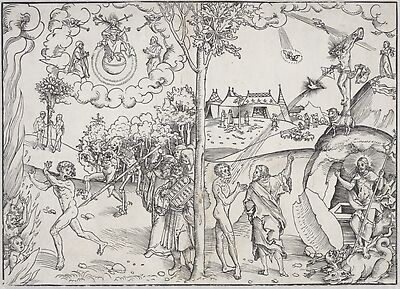
Its artistic fulfilment is found in two works: a painting by Hans Holbein the Younger in the [National Gallery of Scotland, Edinburgh], recently dated to the 1530s, and a painting from 1529 by Cranach in Schloss Friedenstein, Gotha, [DE_SMG_SG676]. This undated Cranach woodcut must have been produced close in time to the latter.
The innovation of this pictorial concept was not the borrowed medieval juxtaposition of sub lege and sub gratia, but the central position of the human figure. However, influenced by Luther and/or Melanchthon, Cranach modified the composition. While Holbein’s version features Isaiah and John the Baptist competing for the viewer’s attention, Cranach depicts the two scenes side by side in historical sequence. Here too, John the Baptist marks the transition, as is noted in the third column of the accompanying text: 'Das gesetz vnd die propheten gehen bis auff Johannes zeit'. (The Law and the Prophets extend to the time of John). The emphasis the shifts and the following column presents a core Lutheran thesis, based on Romans 3:28. 'Wir halten das ein mensch gerecht werde durch den glauben / on werg des gesetzs.' (We hold that a man is justified by faith, not by works of the law.). Accordingly, the right side of Cranach’s composition depicts the believer, guided by John, experiencing God’s grace through the Incarnation.
This Pauline reformulation of 'law and grace' was essentially confined to the Saxon court’s sphere of influence, featuring in paintings from Cranach’s workshop or those of his immediate followers. Yet beyond this—most notably in Holbein’s version—the subject, despite its complexity, became one of the most popular visual motifs of Reformation iconography. Consequently, it appeared across a wide variety of genres, ranging from altarpieces and painted or carved epitaphs to book covers, stained glass, chest reliefs, and stove tiles.
Edition a) A horizontal tear, approx. 30 mm, at the bottom left edge below the neck of the woman in the fires of hell; two losses at the bottom left edge; good, clear prints.
[Armin Kunz 2023]
- Attributions
-
Lucas Cranach the Elder, Inventor*in
Lucas Cranach der Jüngere, Inventor*in
Attributions
| Lucas Cranach the Elder, Inventor*in | [Armin Kunz/cda 2023] |
| Lucas Cranach der Jüngere, Inventor*in | [Hollstein German VI.124.14] |
| Hans Cranach, Inventor*in | [Dodgson 1911, 335, no. 14] |
- Dating
- about 1529
Dating
| about 1529 | [Armin Kunz 2023] |
- Chronology
- about 1530
Chronology
| about 1530 | [Armin Kunz 2023] |
- Dimensions
- Image: 235 x 324/326 mm
Dimensions
Image: 235 x 324/326 mm
[Armin Kunz 2023]
- Signature / Dating
None
- CDA ID
- LC_HVI-124_14
- Bartsch-No
- ---
- GND-No
- http://d-nb.info/gnd/1380228336
- Persistent Link
- https://lucascranach.org/en/LC_HVI-124_14/