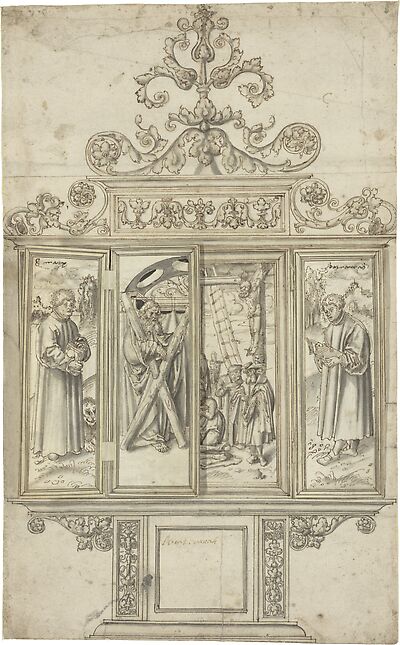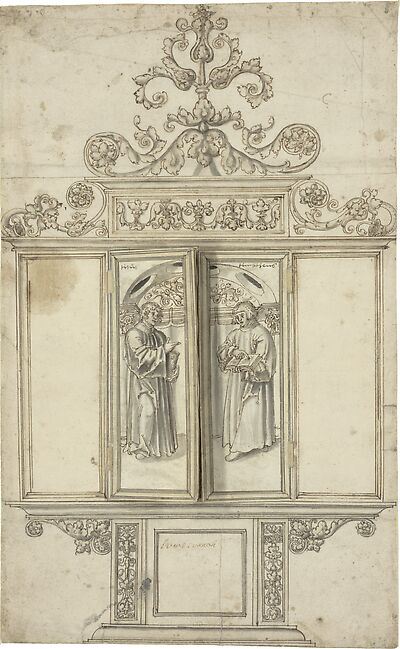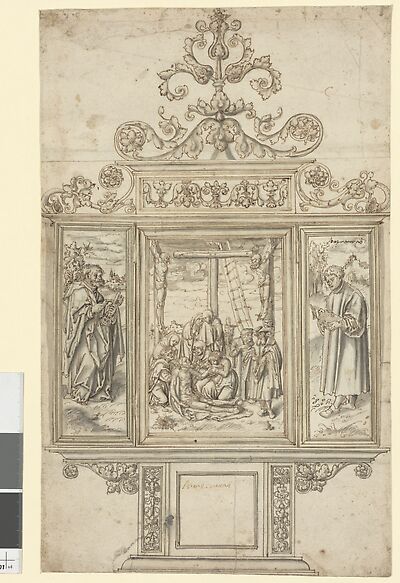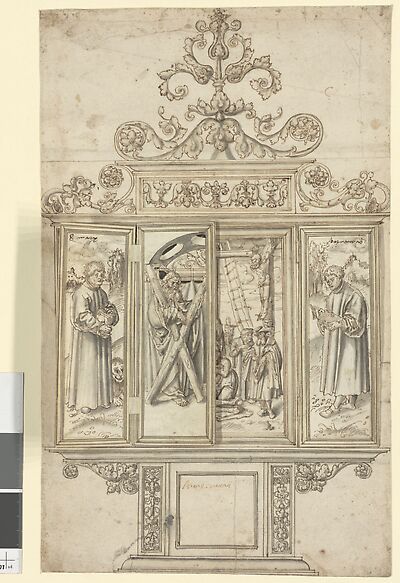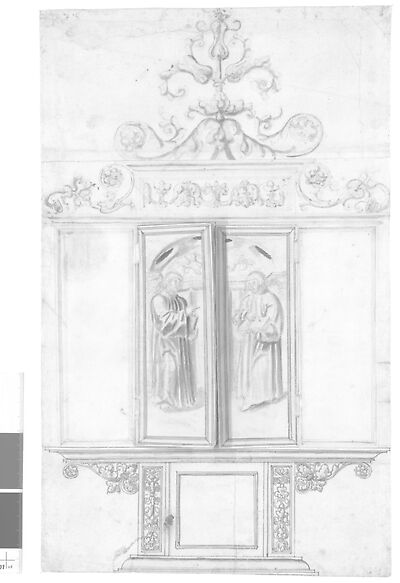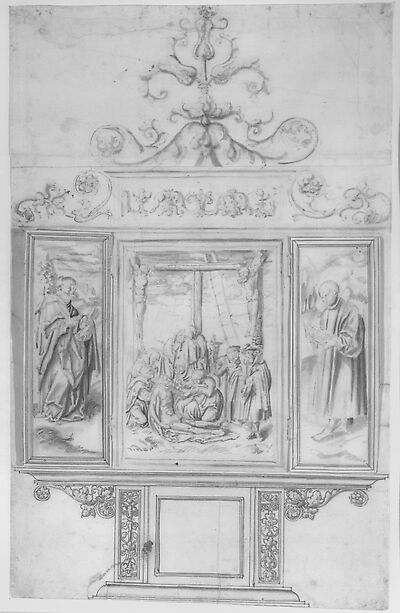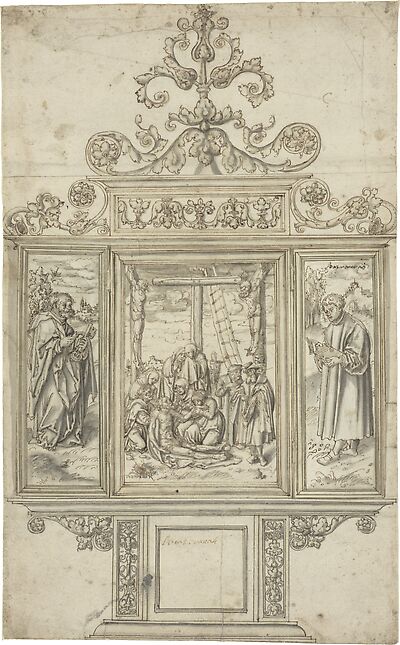
Model for an altar with the lamentation depicted on the central panel

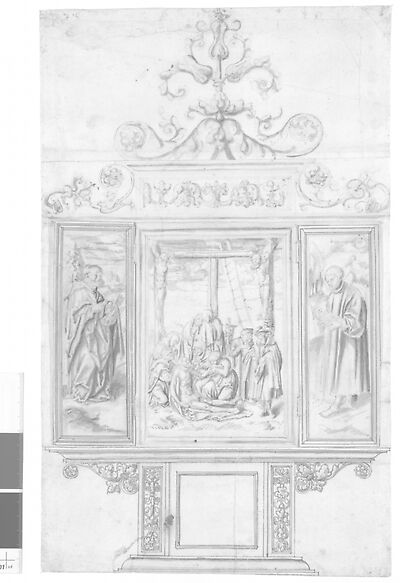
Model for an altar with the lamentation depicted on the central panel

Drawing on laid paper

Medium

Drawing on laid paper
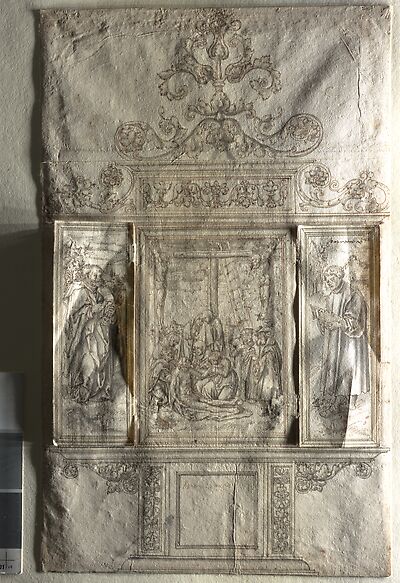
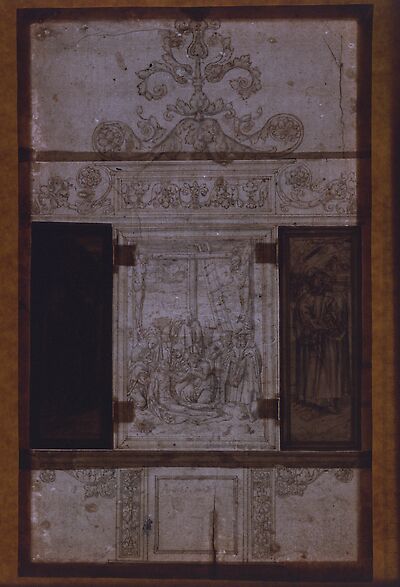
in six parts; central panel: pen and brown ink, brown-grey and grey washes, brush and black ink, over traces of a dry, black drawing material, frame, pen and brown ink, brown-grey and yellow washes; pinholes in all four corners; Blank side panels and lower frieze: pen and brown ink, brown-grey and yellow washes, with pin holes; Superstructure: pen and brown ink, grey wash over a dry, black drawing material;
Predella: pen and grey-black ink, grey and yellow washes, over traces of a dry, black drawing material, pinholes;
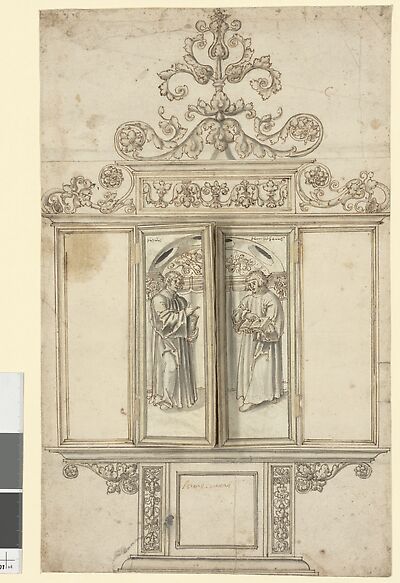
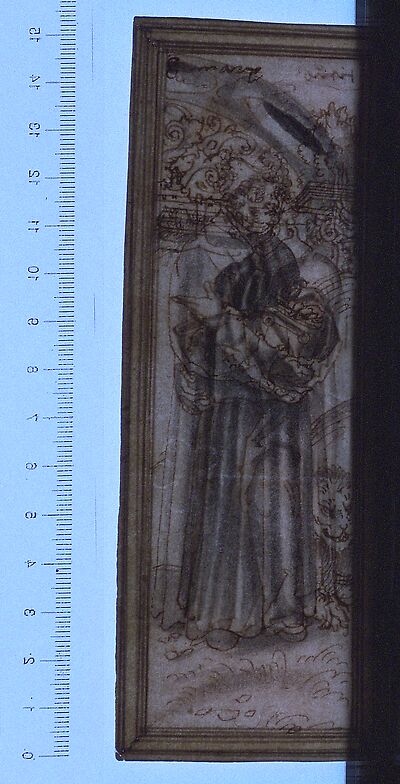
left wing panel a, recto (Mark): pen and brown ink, grey wash, brush and black ink, over dry, black drawing material, frame, pen with brown and grey-black ink, grey and yellow washes;
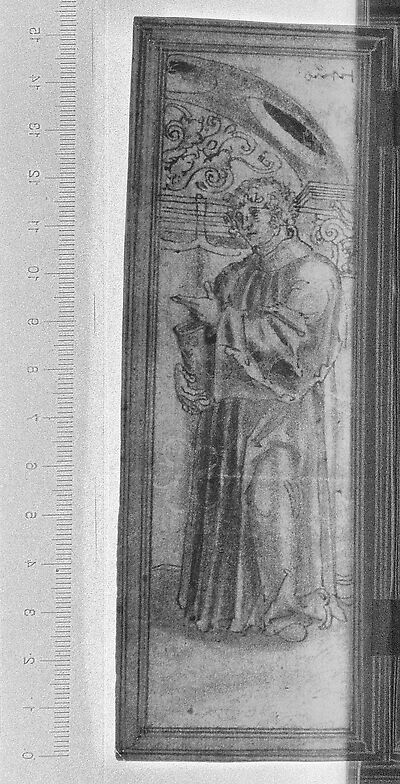
Verso (Titus): pen and brown ink, grey wash, brush and black ink, over a dry, black drawing material, frame, pen and grey-black ink, yellow wash, pinholes;
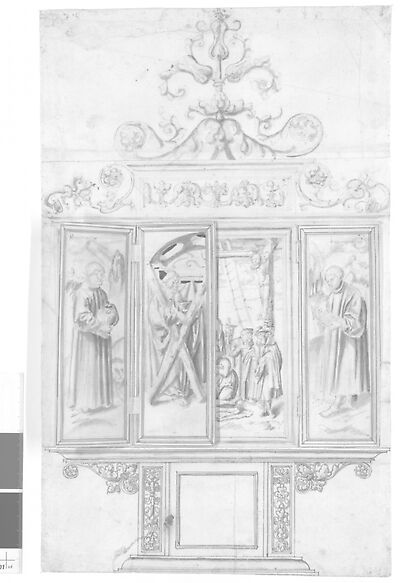
left wing panel b, recto (Peter): pen and brown ink, grey wash, pen and black ink, over dry, black drawing material, frame, pen and grey-black ink, grey and yellow washes, pinholes; Verso (Andrew): pen and brown ink, grey wash; brush and black ink; over dry, black drawing material; frame, pen and grey-black ink, grey and yellow washes; top edge of frame moulding, correction in opaque white paint;
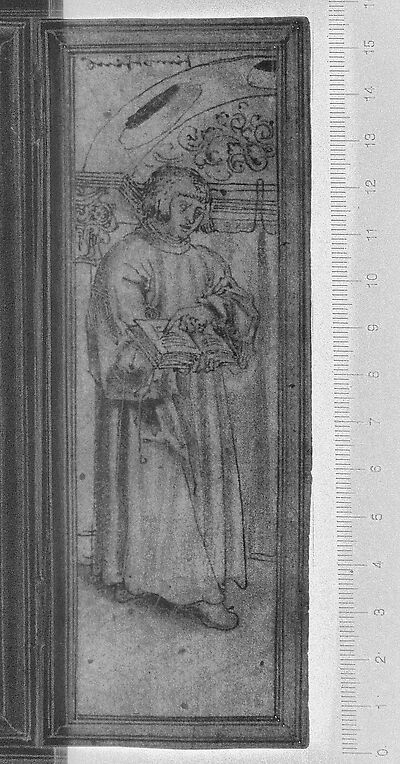
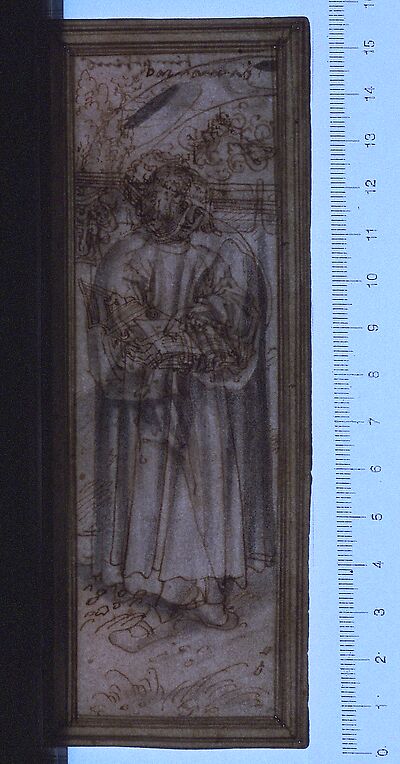
right wing panel a, recto (Barnabas): pen and brown ink, grey wash, brush and black ink, over dry, black drawing material, frame, pen with brown and grey-black ink, grey and yellow washes;
Verso (Timothy): pen and brown ink, grey wash, brush and black ink, over dry, black drawing material, frame, pen and grey-black ink, yellow wash, pinholes; right wing panel b is missing

[Kupferstichkabinett, Staatliche Museen zu Berlin, Stiftung Preußischer Kulturbesitz 2026]

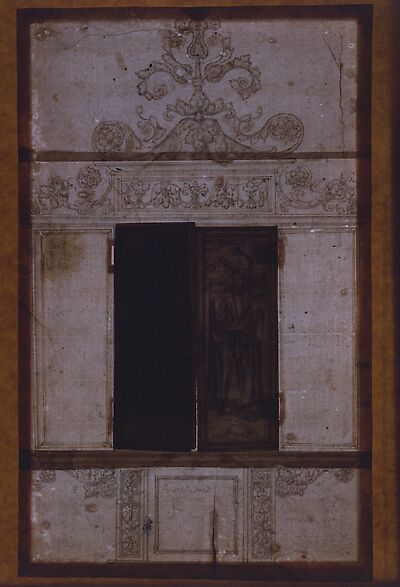
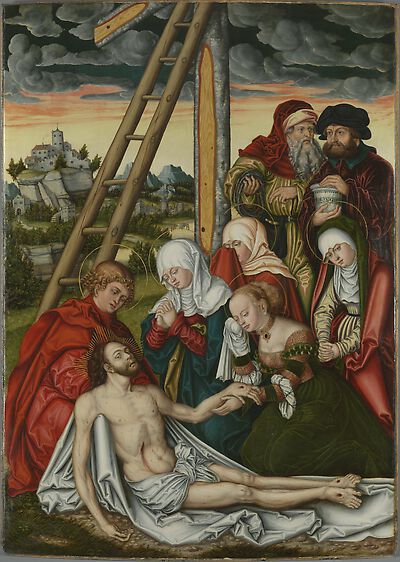
Lucas Cranach the Elder created this composite drawing as a model for an altarpiece with movable wings for his patron, Cardinal Albrecht of Brandenburg. The cardinal had commissioned an extensive program of winged altars and individual panels from Cranach as part of his renovation plans for the collegiate church in

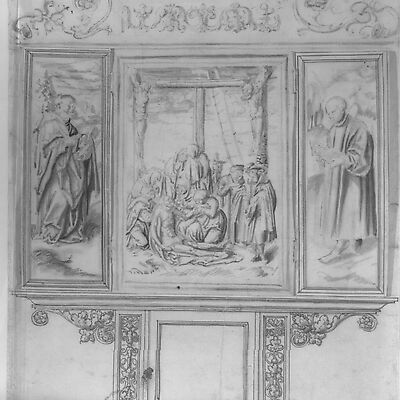
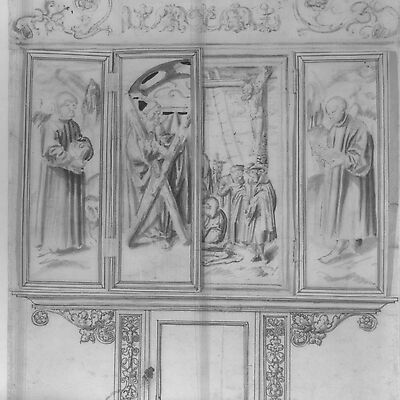
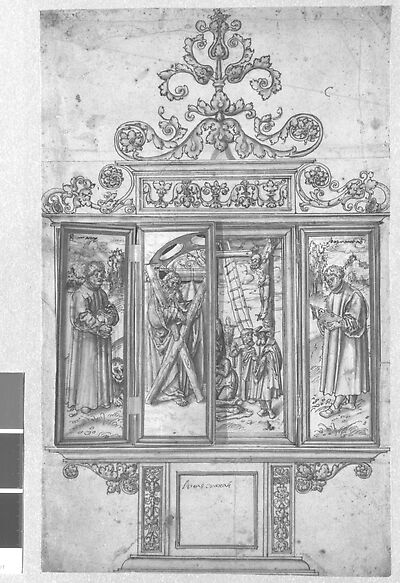
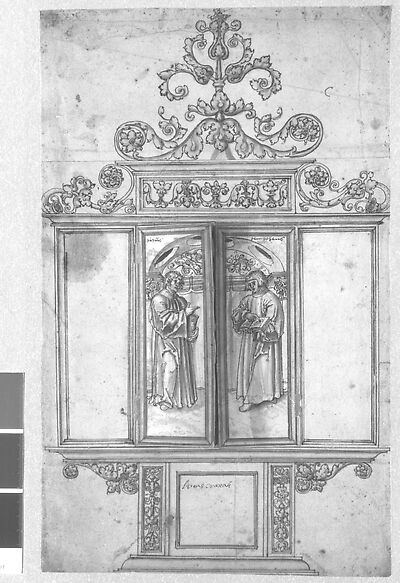
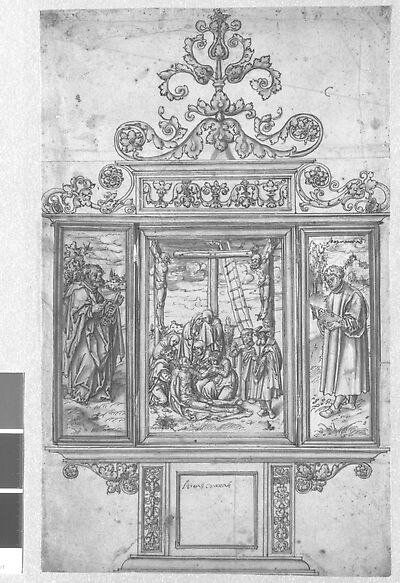
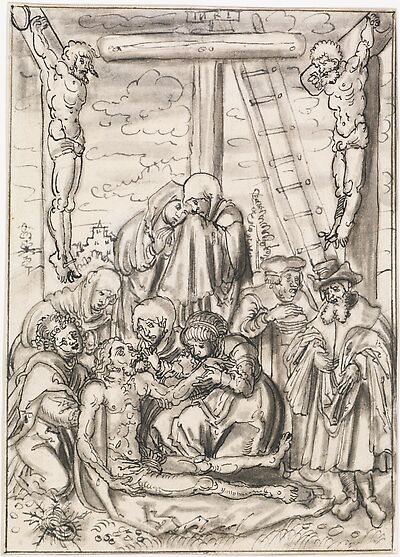
Lucas Cranach the Elder created this composite drawing as a model for an altarpiece with movable wings for his patron, Cardinal Albrecht of Brandenburg. The cardinal had commissioned an extensive program of winged altars and individual panels from Cranach as part of his renovation plans for the collegiate church in Halle. Following the design principles of a medieval winged altar, this altarpiece features a central Passion scene, with saints depicted on both the fixed and movable wing panels. The outer panels were visible when the altarpiece was closed, whereas the central panel and the inner sides of the wings were reserved for display only on major feast days. In the drawings, the artist added the names of the saints to their respective figures. While the painted version of the central Lamentation panel is preserved at Munich's Alte Pinakothek (Inv. 5362), the side wings and the predella are considered lost.

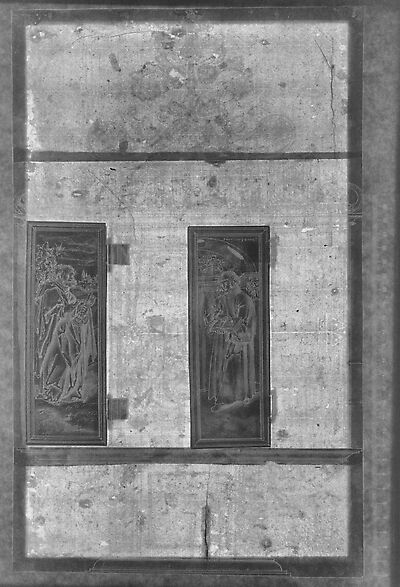
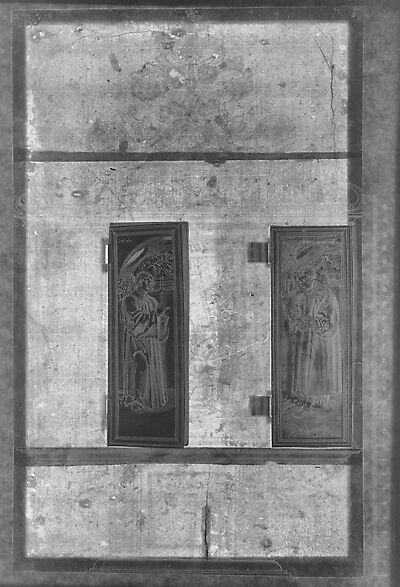
Executed in pen, presumably over a preliminary sketch in charcoal and embellished with washes, these are likely presentation drawings that could have been shown to the client. The pinholes in the corners of the drawings are significant. They provided the dimensional framework and appear on other models from this major commission (see Weimar, [DE_KSW_KK97]; Paris, [F_MdLP_18863]; Leipzig, [DE_MdbKL_NI13] and [DE_MdbKL_NI14]). Cranach drafted the picture planes at a 1:10 scale, making the individual elements interchangeable [Cat. Erlangen 2018, XV]. A rearrangement of the panels could thus be tested in advance using the model.

As the Berlin model represents the final design for an altarpiece, its assembly from multiple sheets of paper is particularly noteworthy: the top section depicts only the superstructure, whereas the predella is drawn on the bottom strip. This suggests that the composition was developed in parallel. Furthermore, the question remains whether the superstructure's carving was designed outside Cranach's workshop and integrated later in the planning process. Given the tight timeframe for Albrecht of Brandenburg's commission and the workshop's ongoing workload, it is highly likely that the model was a collaborative effort. Since the predella—like the frames of the wings—exhibits pen and grey-black ink work and lacks the masterful quality of the other designs, these sections of the model can plausibly be attributed to the workshop, whereas the drawings for the actual pictorial programme are probably by Cranach the Elder. This difference in attribution also aligns with the workshop replicas for the commission, now held in the Erlangen University Library [see Cat. Erlangen 2018, cat. nos. 20–28]; [DE_UBERL_B1274] and [DE_UBERL_B1279–B1282]). In these works, the drawing was also executed with a pen and grey-black ink. By contrast, the sheets attributed to Lucas Cranach the Elder are frequently rendered in brown ink (see e.g., Berlin, [DE_SMBKSK_KdZ5016], and Dresden, [DE_SKD_C2159]).

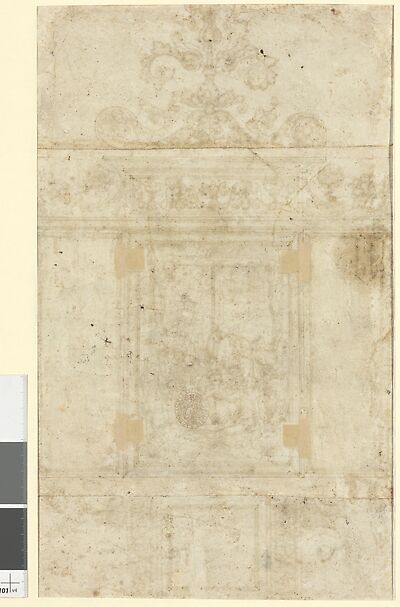
Evidence indicates that all elements of the model were drawn on paper from the same ream. The central panel features a bull’s head watermark, with fragments appearing in two of the smaller side panels (a and b). Furthermore, the six paper pieces share a comparable quality, featuring nearly identical rib line densities and chain line intervals. The same watermark appears in a document from 1509 written in Coburg (reference number: DE1635-PO-66144). Factoring in the service life of paper moulds, the delay between production and use, and typical storage periods, paper historians suggest a probable date-range between 1505 and 1513 (for the calculation, see [Bannasch 1990, 72 and 77]). A later use can still be assumed, as the dating of the designs for the Halle commission is historically substantiated: on August 1, 1518, Albrecht was appointed cardinal and presumably decided shortly afterward to convert the church of the Dominican monastery of the Holy Cross into a new collegiate church.

It was officially founded on 28 June 1520 and consecrated on 23 August 1523. Since the original monastery church was too small to accommodate the extensive painting programme, the commission was almost certainly tied to the planning of the new collegiate church. An inventory from 1525, which also lists the altarpiece depicted in the Berlin model [Redlich 1900, Supplement 17, 54], establishes this year as the terminus ante quem. Given that the model embodies the altarpiece's final design, it can be dated to circa 1520, and definitively not later than 1525, by which time the panels were completed, assembled, and installed [Tacke 1992, 16–18 and 73]. The use of paper beyond the dates suggested by watermark evidence can be explained by longer storage periods [Tschudin 2002, 32 and 44]. Apparently, paper usage in artists’ studios did not follow the same pattern as in scriptoria and publishing houses, whose dated and localizable products form the primary source base for watermark research.

[Georg Josef Dietz, Tabea Harney, Gunnar Heydenreich, Mailena Mallach and Rahel Müller, as part of the Cranach research project, April 2026]

Attributions
Lucas Cranach the Elder
Workshop Lucas Cranach the Elder

Attributions

Lucas Cranach the Elder

[Kupferstichkabinett, Staatliche Museen zu Berlin, Stiftung Preußischer Kulturbesitz 2026]; [Dietz, Messling 2017, 70]; [Hofbauer 2010, 178, no. 56]; [Exhib. Cat. Berlin 1973, 40, no. 38]; [Rosenberg 1960, 21, no. 31]; [Girshausen 1936, no. 35]; [Bock, Cat. Berlin 1921, 19, no. 387]

Workshop Lucas Cranach the Elder

['Predella', Kupferstichkabinett, Staatliche Museen zu Berlin, Stiftung Preußischer Kulturbesitz 2026]

Dating
about 1520
after 1515 - before 1520

Dating

about 1520

[Kupferstichkabinett, Staatliche Museen zu Berlin, Stiftung Preußischer Kulturbesitz 2026]; [Exhib. Cat. Berlin 2009 A, 220, no. IV.25]; [Heydenreich 2007 A, 38]; [Exhib. Cat. Berlin 1973, 38, no. 36]

about 1518 - 1520

[Rosenberg 1960, 21, no. 31]

after 1515 - before 1520

[Girshausen 1936, 34]

1520 - 1525

[Dietz, Messling 2017, 70]

Dimensions
Sheet: 398 x 247 mm (overall dimensions of the three sheets of the upper, middle and lower sections, glued together with overlapping edges); 88 x 247 mm (lower sheet); 201 x 247 mm (middle sheet); 108 x 246 mm (upper sheet); 155 x 57 mm (wing panel a); 158 x 57 mm (wing panel b); 157 x 5.7 cm (wing panel c)

Dimensions

  • Sheet: 398 x 247 mm (overall dimensions of the three sheets of the upper, middle and lower sections, glued together with overlapping edges); 88 x 247 mm (lower sheet); 201 x 247 mm (middle sheet); 108 x 246 mm (upper sheet); 155 x 57 mm (wing panel a); 158 x 57 mm (wing panel b); 157 x 5.7 cm (wing panel c)

  • [Kupferstichkabinett, Staatliche Museen zu Berlin, Stiftung Preußischer Kulturbesitz 2026]

Signature / Dating

Artist's insignia, central section, bottom right, pen and brown ink (mixed): serpent with elevated wings

Signature / Dating

  • Artist's insignia, central section, bottom right, pen and brown ink (mixed): serpent with elevated wings

  • [Kupferstichkabinett, Staatliche Museen zu Berlin, Stiftung Preußischer Kulturbesitz 2026]

Inscriptions

various iron gall inks:
top left, 'C' (pen and grey-brown ink), 'titus' (pen and brown ink); top left, 'S …

Inscriptions

Inscriptions:

  • various iron gall inks:

  • top left, 'C' (pen and grey-brown ink), 'titus' (pen and brown ink); top left, 'S marc' (pen and brown ink); top right, 'Barnabas' (pen and brown ink); top right 'Timotheus' (pen and brown ink)

  • [Kupferstichkabinett, Staatliche Museen zu Berlin, Stiftung Preußischer Kulturbesitz 2026]

Labels

On the predella, pen and brown (iron gall ink): 'Lucas Cranah' (not genuine)
Verso, centre, collection stamp in brown …

Labels

later inscription, stamps, seals, labels:

  • On the predella, pen and brown (iron gall ink): 'Lucas Cranah' (not genuine)

  • Verso, centre, collection stamp in brown ink: Kupferstichkabinett, Berlin [Lugt 1609]

  • [Kupferstichkabinett, Staatliche Museen zu Berlin, Stiftung Preußischer Kulturbesitz 2026]

Owner
Kupferstichkabinett, Staatliche Museen zu Berlin, Stiftung Preußischer Kulturbesitz
Repository
Kupferstichkabinett, Staatliche Museen zu Berlin, Stiftung Preußischer Kulturbesitz
Location
Berlin
CDA ID
DE_SMBKSK_KdZ387
Persistent Link
https://lucascranach.org/en/DE_SMBKSK_KdZ387/

Provenance

Rumohr collection
[Cat. Berlin 1921, 19, no. 387]

Exhibitions

Berlin 1937, no. 138
Berlin 1973, no. 36
Berlin/Basel 1994, no. 17.3
Halle 2006, no. 77
Berlin 2009, no. IV.25

Literature
Reference on page Catalogue Number Figure / Plate
Dietz, Messling 2017 68, 70
AuthorGeorg Josef Dietz, Guido Messling
TitleCranach der Ältere als Zeichner
Publicationin Gunnar Heydenreich, Daniel Görres, Beat Wismer, eds., Lucas Cranach der Ältere. Meister - Marke - Moderne. [Exhib. Cat. Düsseldorf 2017]
Place of PublicationMunich
Year of Publication2017
Pages66-71
Hofbauer 2010 178-181
AuthorMichael Hofbauer
TitleCranach - die Zeichnungen
Place of PublicationBerlin
Year of Publication2010
Exhib. Cat. Berlin 2009 A 220, 221
EditorStiftung Preussische Schlösser und Gärten Berlin-Brandenburg
TitleCranach und die Kunst der Renaissance unter den Hohenzollern. Kirche, Hof und Stadtkultur
Place of PublicationBerlin
Year of Publication2009
Heydenreich 2007 A 38
AuthorGunnar Heydenreich
TitleLucas Cranach the Elder
Place of PublicationAmsterdam
Year of Publication2007
Link https://lucascranach.org/application/files/6116/2097/3099/Heydenreich_2007_Lucas_Cranach_the_Elder.pdf
Exhib. Cat. Halle 2006
EditorThomas Schauerte
TitleDer Kardinal Albrecht von Brandenburg. Renaissancefürst und Mäzen. Bd. 1: Katalog zur Ausstellung in Halle, Moritzburg
Volume1
Place of PublicationRegensburg
Year of Publication2006
Exhib. Cat. Basel 1997
EditorKupferstichkabinett, Basel, Gerhard Brunner, Kunstmuseum Basel
TitleDürer, Holbein, Grünewald. Meisterzeichnungen der deutschen Renaissance aus Berlin und Basel [Basel, Kunstmuseum, 14.05- 24.08.1997; Berlin, Kupferstichkabinett, Staatliche Museen zu Berlin, 05.06-23.08.1998]
Place of PublicationBasel
Year of Publication1997
Tacke 1992 257
AuthorAndreas Tacke
TitleDer katholische Cranach. Zu zwei Großaufträgen von Lucas Cranach d. Ä., Simon Franck und der Cranach-Werkstatt (1520 - 1540)
SeriesBerliner Schriften zur Kunst
Volume2
Place of PublicationMainz
Year of Publication1992
Exhib. Cat. Berlin 1973 38, 39
AuthorWilhelm H. Köhler, Frank Steigerwald
TitleLucas Cranach. Gemälde, Zeichnungen, Druckgraphik
Place of PublicationBerlin
Year of Publication1973
Jahn, Bernhard 1972 60-69
AuthorJohannes Jahn
EditorMarianne Bernhard
TitleLucas Cranach der Ältere: 1472 - 1553. Das gesamte graphische Werk. Mit Exempeln aus dem graphischen Werk Lucas Cranach des Jüngeren und der Cranachwerkstatt
Place of PublicationMunich
Year of Publication1972
Rosenberg 1960 21
AuthorJakob Rosenberg
TitleDie Zeichnungen Lucas Cranachs d.Ä.
Place of PublicationBerlin
Year of Publication1960
Link https://doi.org/10.11588/diglit.42777
Exhib. Cat. Berlin 1937
EditorStaatliche Museen, Berlin
TitleLucas Cranach d. Ä. und Lucas Cranach d. J. Gemälde, Zeichnungen, Graphik
Place of PublicationBerlin
Year of Publication1937
Girshausen 1936 34, 35, 68
AuthorTheo Ludwig Girshausen
TitleDie Handzeichnungen Lukas Cranachs des Älteren
Place of PublicationFrankfurt/Main
Year of Publication1936
Link https://doi.org/10.11588/diglit.23708
Cat. Berlin 1921 19
AuthorElfried Bock
TitleDie Zeichnungen alter Meister im Kupferstichkabinett. Die deutschen Meister. Beschreibendes Verzeichnis sämtlicher Zeichnungen, Staatliche Museen zu Berlin
Place of PublicationBerlin
Year of Publication1921
Link https://digi.ub.uni-heidelberg.de/diglit/bock1921ga
Schuchardt 1851 C 26
AuthorChristian Schuchardt
TitleLucas Cranach des Aeltern Leben und Werke. Zweiter Theil
Place of PublicationLeipzig
Year of Publication1851
Link http://digi.ub.uni-heidelberg.de/diglit/schuchardt1851bd2
  • Model for an altar with the lamentation depicted on the central panel, about 1520

Images

Compare images
  • overall
  • overall
  • overall
  • overall
  • overall
  • overall
  • reverse
  • irr
  • irr
  • irr
  • irr
  • irr
  • irr
  • irr
  • uv_light
  • uv_light
  • uv_light
  • other
  • transmitted_light
  • transmitted_light
  • transmitted_light
  • transmitted_light
  • transmitted_light
  • transmitted_light
  • transmitted_light
  • transmitted_light
  • transmitted_light
  • transmitted_light
  • transmitted_light
  • transmitted_light

Download illustration

Technical studies

2026Technical examination / Scientific analysis

  • Examination of paper / structural analysis

Support

Paper type: laid

Chain lines, orientation to image: horizontal (in all sheets)

Chain lines (intervals): [.]-31-30-[.] mm (bottom sheet); [.]-30-31-30-31-31-32-[.] mm (central sheet); [.]-32-31-[.] mm (top sheet); not identifiable (wings a and c); [.]-31-31-30-31-[.] mm (wing b)

Laid lines (density): 11/10 mm (bottom, central and top sheets); not identifiable (wings a and c); 10/10 mm (wing b)

Mould side: wire side (top and bottom); felt side (central sheet)

Formation: uniform distribution of fibres

Paper defects: knots and slivers, cloudy (top and bottom edge)

Shadow lines: present

Mould defects: none

[Kupferstichkabinett, Staatliche Museen zu Berlin, Stiftung Preußischer Kulturbesitz 2026]

Process, Medium

The multi-winged model altarpiece can be broadly divided into three main groups:

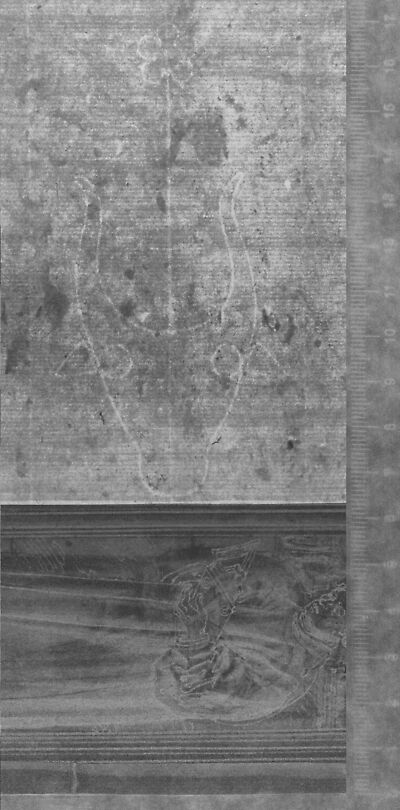
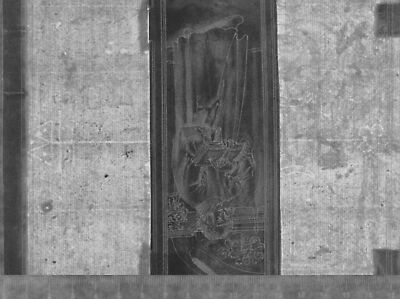
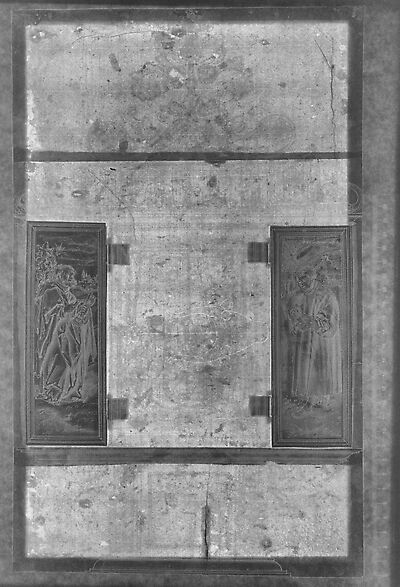
The central panel (middle sheet) exhibits a slightly warmer tone than the wing panels. This probably results from a wash in the sky, which may contain some iron gall ink, causing it to appear less cool than the corresponding washes on the wing panels. Iron gall ink was evidently used for the brown linear pen drawing. Its iron vitriol content was identified through X-ray fluorescence analysis (XRF, M3) by the presence of iron (Fe) and copper (Cu), as well as by the fact that the ink disappears in infrared reflectography (IRR). This is particularly evident in the framing lines and the crown of thorns at the front left. By contrast, the winged serpent at the front right was evidently executed with a brush in grey (lamp black ink) and therefore remains visible. Infrared reflectography (IRR) also revealed a preparatory charcoal drawing, in which the ladder is still positioned against the left side of the cross. Similarly, the group of mourners shows traces of an initial sketch. Furthermore, the washes display a high carbon content in IRR, indicating the use of lamp black ink. XRF analysis, which might have revealed the presence of vitriol, was not carried out here. It is evident that the artist finished the drawing by applying black ink with a brush to create the deepest shadows—for example, in the robe of the kneeling John on the far left—or to render the bark texture on the crossbeam on the right. The delicate yellowish wash applied to the frames and the crossbeam is particularly noteworthy. Numerous pinholes in all four corners of the frame stem from the method used to maintain a consistent scale across all models.

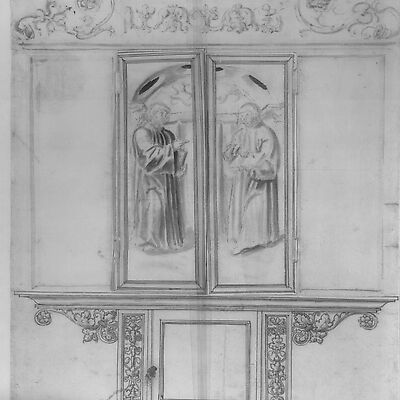
The same technique was used for the folding wings, except for the linear framing, which corresponds to the predella (see below). The pen-and-ink drawings (and text), which appear very dark brown in places, disappear IRR and can thus be identified as iron gall ink. There are preparatory drawings in black (probably charcoal), and the carbon-based washes remain clearly discernible. On the wings depicting interiors, construction lines, incised compass arcs, and pinholes in the corners of the frame are clearly visible. The wings also feature final adjustments applied in dark black ink with a brush—very noticeable in the architecture, as well as in the folds of the drapery. An examination of the wing depicting the Apostle Peter clarifies the sequence of line drawing and wash. Since the lines in iron gall ink were visibly smudged by the wash, the drawing must have been executed first.

XRF measurements for each of the superstructure’s linear brown pen-and-ink drawings (M4 on the central sheet and M6 on the upper sheet) indicate the use of iron gall ink. This is evidenced by the presence of iron (Fe), copper (Cu), and zinc (Zn), combined with the drawings' invisibility in infrared reflectography (IRR). The grey wash on the superstructure in the upper sheet matches the washes on the folding wings in its cool hue. It contains slightly varying levels of iron (Fe) and copper (Cu), but no zinc (Zn). This could indicate the presence of vitriol in the lamp black ink or a contaminated brush.

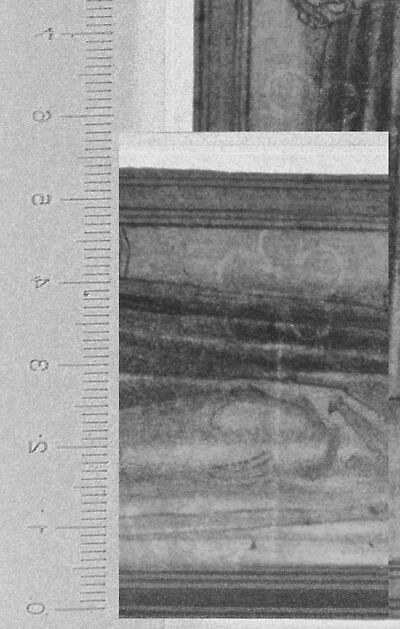
The lower sheet of paper (featuring the predella) and the linear outlines of the folding wings attached to the central sheet differ. Examination using infrared reflectography (IRR) revealed the use of a highly concentrated, fully visible, carbon-based ink. In the predella, XRF (M1) analysis detected the presence of vitriol, identified by the profile elements iron (Fe), copper (Cu), and zinc (Zn). This suggests two possibilities: either an iron gall ink mixed with carbon or soot, or a lamp black ink enhanced with iron vitriol. The washes appear to consist solely of lamp black ink. Finally, the ‘Lucas Cranach’ inscription disappears under IRR, confirming it was applied using pure iron gall ink.

The paper (XRF M2 (lower sheet), M7 (upper sheet), middle sheet not measured) contain calcium (Ca) and iron (Fe) and possibly also some copper (Cu)?

[Georg Josef Dietz, drawing on results from infrared reflectography and analytical evaluations by Gunnar Heydenreich and Sarah Critchley, as well as a joint study with Mailena Mallach, Luise Maul and Dominika Ropers (née Wojciechowska), March 2026]

2026Technical Examination

  • Watermark

Watermark: present

Watermark, motif: central section, centre left, bull's head with a single contour rod and flower, below two horizontal lines, a triangle with two diagonal lines and three dots; centre left (wing panel a, left), fragment, bull's head with a single contour rod and flower; centre right (wing panel b, left), fragment, bull's head with a single contour rod and flower

Watermark, dimensions: central section, 173 x 52 mm

[Kupferstichkabinett, Staatliche Museen zu Berlin, Stiftung Preußischer Kulturbesitz 2026]

https://www.wasserzeichen-online.de/?ref=DE1635-PO-66144

25.07.2025Scientific analysis

  • Instrumental material analysis

X-ray fluorescence (XRF) (Thermo Scientific - Niton XL3t GOLDD+)

The following elements were detected using XRF and in conjunction with their optical characteristics the following fillers, drawing media and colourants could be identified:

M1 Black (drawing medium): Ca, Fe, (Cu), (Zn)

Ca: chalk/gypsum (?); Fe: iron oxide (?); Fe/Cu/Zn: iron gall ink

M2 Paper: Ca, Fe, (Cu)?

Ca: chalk/gypsum (?); Fe: iron oxide

M3 Black/brown (drawing medium): Ca, Fe, (Cu)?

Ca: chalk/gypsum (?); Fe: iron oxide (?); Fe/Cu: iron gall ink (?)

M4 Black (drawing medium): Ca, Fe, (Cu), (Zn)

Ca: chalk / gypsum (?); Fe: iron oxide (?); Fe/Cu/ Zn: iron gall ink

M5 Black (wash): Ca, Fe, (Cu)?

Ca: chalk / gypsum (?); Fe: iron oxide (?); Fe/Cu: iron gall ink (?)

M6 Black/brown (drawing medium): Ca, Fe, (Cu), (Zn)

Ca: chalk/gypsum (?); Fe: iron oxide (?); Fe/Cu/Zn: iron gall ink

M 7 Paper: Ca, Fe, (Cu)?

Ca: chalk/gypsum (?); Fe: iron oxide

[Gunnar Heydenreich, Sarah Critchley, unpublished analysis report, 25.07.2025]

  • examined by Gunnar Heydenreich
  • examined by Sarah Critchley

Citing from the Cranach Digital Archive

Entry with author
<author's name>, 'Model for an altar with the lamentation depicted on the central panel', <title of document, data entry or image>. [<Date of document or image>], in: Cranach Digital Archive, https://lucascranach.org/en/DE_SMBKSK_KdZ387/ (Accessed {{dateAccessed}})
Entry with no author
'Model for an altar with the lamentation depicted on the central panel', <title of document, data entry or image>. [<Date of document, entry or image>], in: Cranach Digital Archive, https://lucascranach.org/en/DE_SMBKSK_KdZ387/ (Accessed {{dateAccessed}})

Help us to improve the Cranach Digital Archive.

Please contact us, if you have noticed a mistake.