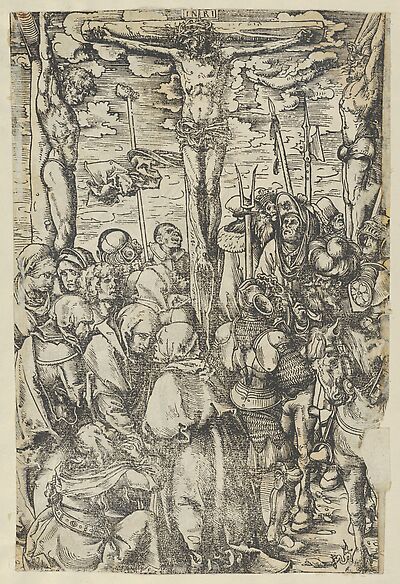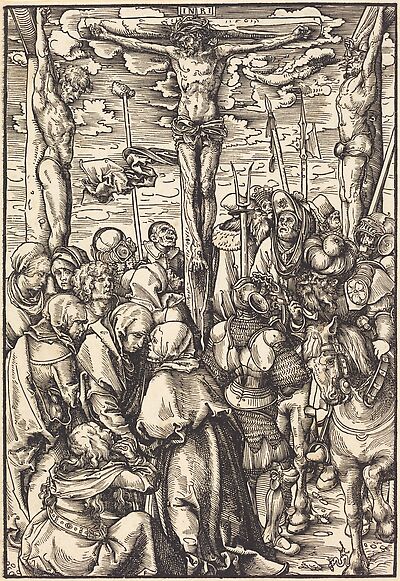
The Crucifixion represents Christ on the cross in a frontal view at the center of the composition, with the two thieves in parallel postures turned ninety degrees to form side views. In the case of both thieves, the crossbar (the patibulum) and the arm or hand of the respective thieves
The Crucifixion represents Christ on the cross in a frontal view at the center of the composition, with the two thieves in parallel postures turned ninety degrees to form side views. In the case of both thieves, the crossbar (the patibulum) and the arm or hand of the respective thieves are truncated by the border lines. This symmetry is further emphasized by the placement of the sponge and the lance, each of which is equidistant from the cross post (stipes) on both sides. On the left is a cluster of six women and the Apostle John. Mary is in the center of a subgroup of three women and John. The woman kneeling in prayer in the foreground left is Mary Magdalene. There are three additional men on the left, one of whom is a soldier holding the sponge on a pole; the other two may be looking at Christ empathetically. Christ’s executioners are arrayed on the right. Cranach has not included the centurion who recognizes Christ’s divinity (Mark 15:39), a common Cranach motif in other compositions, though one figure does gaze on Christ intensely, perhaps with sympathy. The turbaned figure on horseback (foreground on the right), who makes a finger gesture similar to that of the faithful centurion, has been identified by some scholars as Herod, but is most likely Pilate. After all, Herod is not recorded as being present under the cross, whereas in John 19:19-22 Pilate orders that the so-called “titulus crucis” (i.e., the inscription “Jesus of Nazareth King of the Jews”) be fastened to the top of the cross, as it is in this image. Moreover, the bearded, turbaned head conforms to Cranach’s portrayal of Pilate in other images of the Passion. The sky is heavy with clouds, probably in an attempt to represent the Crucifixion darkness; according to Luke 23:44-24, “about the sixth hour, and darkness fell over the whole land until the ninth hour, because the sun was obscured.”
While this is the only woodcut in the series that lacks the Saxon heraldic shields, Cranach signed the composition with his winged-serpent insignia on the lower right.
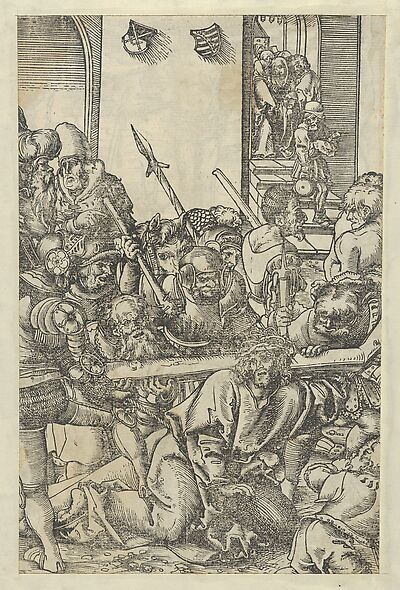
In the 1509 Passion, the Crucifixion is the illustration for both the “Betrachtung Zu der Sext zeit” and the “Betrachtung Zu der Non zeit,” both of which are printed folio 8v. In the first Lutheran reprint of the images, Antonius Corvinus’s Die Passion Christi/ jnn VI. Predigt geteilet (Wittenberg: Georg Rhau, 1538), Christ Bearing the Cross and the Crucifixion, are printed back-to-back on folios XIIIr and XIIIv, as the concluding illustrations for Corvinus’s fifth sermon (which is to be delivered on Good Friday). In the 1543 Passional Buch (Wittenberg: Georg Rhau), the Crucifixion was printed twice (on folios LXVIIIv and LXIXv). Altogether, the Crucifixion appeared in at least eleven evangelical books printed in Wittenberg. See the list of the book publications of the woodcuts from Cranach’s Passion.
The composition served several times as a model for altarpiece paintings and carved reliefs in places scattered across northern Europe. See Löcher 1990, 36-37, for details.
Bibliography
Geisberg, Max. The German Single-Leaf Woodcut: 1500-1550. Revised edition by Walter L. Strauss, 4 vols. New York: Hacker, 1974.
Heydenreich, Gunnar, Daniel Görres, and Beat Wismer. Lucas Cranach der Ältere: Meister, Marke, Moderne. Munich: Hirmer, 2017.
Hollstein, F. W. H. German Engravings, Etchings and Woodcuts, ca. 1400-1700. Vol. 6 (Lucas Cranach). Edited by K. G. Boon and R. W. Scheller. Amsterdam: Hertzberger, n.d.
Jahn, Johannes. Lucas Cranach als Graphiker. Leipzig: E. A. Seemann, 1955.
Koepplin, Dieter, and Tilman Falk. Lukas Cranach. 2 vols. Basel and Stuttgart: Birkhäuser Verlag, 1974-1976.
Löcher, Kurt. “Cranachs Holzschnitt-Passion von 1509: Ihre Wirkung auf die Künste.”
Anzeiger des Germanischen Nationalmuseums und Berichte aus dem Forschungsinstitut für Realienkunde 1990:9-52.
Use in book editions:
a) Der Passion vnsers herren || Jhesu Cristi mit vil || schonen Be=||trachtũgen.||, Symphorian Reinhart, Wittenberg, 1509, [VD16 ZV 31527, accessed 19.04.2026]
b) Antonius Corvinus: Kurtze vnd ein=||feltige Auslegung der || Episteln vnd Euangelien/ so || auff die Sontage vnd fur=||nemisten Feste durchs || gantze jar/ jnn der || Kirchen gelesen || werden.|| Vor die arme Pfar=||herrn vnd Hausveter ge=||stelt/ Durch M. Antoni=||um Coruinum.|| ... ||, Georg Rhau, Wittenberg, 1539, [VD16 C 5350, accessed 19.04.2026]
c) Passional || Buch.|| Vom Leiden || vnd Aufferstehung vnsers || Herrn Jhesu Christi/ Auch anderer || Artickel vnsers Christlichen Glaubens/|| etliche sch#[oe]ne B#[ue]chlin vnd Predigte/|| der wirdigen vnd hochgelarten herrn/|| D.Vrbani Rhegii/ Johannis Kimei /|| D.Johannis Bugenhagen Pomera=||ni/ Vnd D Martini Lutheri.|| ... ||, Georg Rhau, Wittenberg 1539, [VD16 B 4780, accessed 19.04.2026]
d) Passional || Buch. Vom Leiden || vnd Aufferstehung vnsers || Herrn Jhesu Christi/ Auch anderer || Artickel vnsers Christlichen Glaubens/|| etliche sch#[oe]ne B#[ue]chlin vnd Predigte/|| der wirdigen vnd hochgelarten herrn/|| D.Vrbani Rhegij/ Johannis Kimei/|| D.Johannis Bugenhagen Pomera=||ni/ Vnd D. Martini || Lutheri.|| ... ||, Georg Rhau, Wittenberg 1540, [VD16 B 4782, accessed 19.04.2026]
e) Antonius Corvinus: Kurtze vnd ein=||feltige Auslegung der || Episteln vnd Euangelien/ so || auff die Sontage vnd f#[ue]r=||nemisten Feste durchs || gantze Jar/ jnn der || Kirchen gelesen || werden.|| Vor die arme Pfar=||herrn vnd Hausveter ge=||stelt/ Durch M. Antoni=||um Coruinum.|| Auffs new mit vleis corrigirt.|| ... ||, Georg Rhau, Wittenberg 1543, [VD16 C 5354, accessed 19.04.2026]
f) Passional || Buch.|| Vom Leiden vnd Aufferste=||hung vnsers Herrn Jhesu Christi/ Auch || anderer Artickel vnsers Christlichen Glau||bens/ etliche sch#[oe]ne B#[ue]chlin vnd || Predigte/ der wirdigen vnd || hochgelarten herrn/|| D. Vrbani Rhegij/ Johannis Kimei/ D.|| Johannis Bugenhagen Pomerani/ Vnd || D. Martini Lutheri.|| ... ||, Georg Rhau, Wittenberg 1543, [VD16 B 4786, accessed 19.04.2026]
g) Passional || Buch.|| Vom Leiden vnd Aufferste=||hung vnsers Herrn Jhesu Christi/ Auch || anderer Artickel vnsers Christlichen Glau||bens/ etliche sch#[oe]ne B#[ue]chlin vnd || Predigte/ der wirdigen vnd || hochgelarten herrn/|| D. Vrbani Rhegij/ Johannis Kymei/ D.|| Johannis Bugenhagen Pomerani/ Vnd || D. Martini Lutheri.|| ... ||, Georg Rhau, Wittenberg 1561, [VD16 B 4808, accessed 19.04.2026]
h) Martin Luther: Huß Postilla || Aver de Euangelia der Sonda=||ge vnde vornemesten Feste/ dorch || dat gantze Jar.|| Doctor Martinus Luther.|| Upt nye auersehen vnde vormehret/ Sampt der Passion/ vnde lydende || Jhesu Christi/ dorch D. M. Luther geprediget/ vth der latesten Husspostillen yn d#[oe]rtein Predigten gestellet/ dorch || Vitum Theodorum.||, Georg Rhau, Wittenberg 1570, [VD16 ZV 10117, accessed 19.04.2026]
i) Passio D. N. Iesu Christi Venustissimis Imaginibus Eleganter Expressa Ab, Illustrissimi Saxoniae Ducis, Pictore Luca Cranogio. Nicolaus Ioannis Visscherius, Amsterdam 1616.
Der Passion vnsers herren Jhesu Cristi mit vil schonen Betrachtu[n]gen. [Wittenberg: Symphorian Reinhart, 1509]
In 1509, a devotional tract on the Passion of Christ was published with German poetry and fourteen intricate, full-page woodcut prints by Lucas Cranach [1]. In several respects, the pamphlet is a mystery. Neither the author of the poetic meditations nor the printer nor the place of publication is identified. Cranach, however, is credited as the artist: he signed three woodcuts on the block with his winged-serpent insignia, and a fourth one, the second image of the pamphlet, Christ Taken Captive, displays the insignia and his initials (LC) with the year 1509 in a cartouche, thus providing the only evidence (which is not entirely definitive) for dating the book. In addition, Christ Taken Captive includes a self-portrait of the artist as a courtier or soldier at the far right, upper edge of the crowd [2]. His manner sets him apart, for unlike the violent actors in the dramatic woodcut, Cranach is absorbed in intense, empathetic contemplation of Jesus.
The pamphlet text begins with a poetic tribute to Elector Friedrich the Wise of Saxony, who likely commissioned the project, and each of the woodcuts, with the exception of the Crucifixion, prominently displays two of the elector’s coats of arms, thereby trademarking this imprint as a product of Electoral Saxony’s burgeoning religious-artistic culture. As the repository of a vast collection of sacred relics, and as the host of a new university (founded in 1502) dedicated to supporting Christian-humanist education, the electoral residence of Wittenberg was becoming a major religious center, an effort that Cranach as the new court artist (as of 1505) catalyzed. In fact, the work is one of several publications from 1509 with Cranach contributions designed to promote the religious ambitions of Saxony across the Holy Roman Empire. Among the others are the Book of Relics (Dye zaigung des hochlobwirdigen hailigthums der Stifft kirchen aller hailigen zu Wittenburg), the Martyrdom of the Twelve Apostles (Hie nach folgen gebett von den heiligen zwelff botten), and Christoph Scheurl’s laudatory oration for the University of Wittenberg (Oratio doctoris Scheurli attingens litterarum prestantiam/ necnon laudem Ecclesie Collegiate Vittenburgensis). Scheurl’s Wittenberg panegyric, moreover, is dedicated to Cranach, an acknowledgment of the artist’s central role in the advancement of Christian-humanist culture in Saxony [3]. The Oratio pamphlet, though printed in Leipzig, uses Cranach’s woodcut of the Wittenberg Church of All Saints (also called the Castle Church), a principal venue for university functions (and the likely venue for Scheurl’s speech). That woodcut was also printed in the Book of Relics in the same year (and in a second, revised edition of 1510) as a guide to the collection of relics housed in the Church of All Saints and the indulgences attached to them [4].
Rendered in simple, sometimes rough Knittelvers (doggerel), the poetry discloses no concrete information about the author’s identity, although it strongly suggests someone who was familiar with Friedrich’s court and who, as stated at the end of the dedicatory poem, was hoping to serve the elector in subsequent projects. We might consider the possibility of Cranach’s authorship, but such a conjecture would be implausible because the artist, unlike others such as Albrecht Dürer, is not known to have written Knittelvers nor does the poem’s narrator make any allusions to status as the court painter. The handling of the Knittelvers is similar to the style in other Saxon publications, such as Wolff Cyclop’s dedicatory poem for a 1512 anthology of devotional poetry by the recently deceased musician Adam von Fulda, printed in honor of the future Elector John of Saxony, Friedrich’s brother, with woodcut illustrations by Cranach and workshop. Adam von Fulda’s poetry is in doggerel as well, but of a different quality: it has a noticeably smoother ductus and, distinctively, features numerous macaronic insertions of Latin phrases. Cyclop’s edition of Adam von Fulda is also significant because it provides the foundation for attributing the 1509 presswork to the Wittenberg printer Symphorian Reinhart: the 1512 colophon explicitly credits Reinhart as the printer, a useful piece of information because the type used in this imprint matches that of the Passion, the Martyrdom of the Twelve Apostles, and the Book of Relics. Thus, it is highly likely that Cyclop’s edition originated in the same religious-artistic milieu as the Passion, even if the 1512 woodcuts, which are unsigned but attributed to the Cranach workshop, lack the complexity and vibrancy found in the Passion. They are more compatible with the somewhat simpler, looser manner of the woodcuts in the Book of Relics.
The Passion organizes the events of Holy Friday, blow-by-blow, under the rubrics of the seven canonical hours of prayer (omitting Lauds), with each hour focusing on one or more episodes in the Gospel accounts. This technique of pegging reflection on Christ’s Passion to the canonical hours of the day occurs in other works from the late Middle Ages and early Renaissance, notably in a well-known Latin hymn Patris Sapientia (a standard part of the Office of the Holy Cross), a work that no less a figure than Albrecht Dürer translated into German doggerel and published in 1509 as a broadside titled Seven Hours of Prayer (printed poem with a woodcut of the Crucifixion) [5]. The medieval Patris Sapientia, with its seven canonical hours of concise Passion devotion, is also the text interleafed in Friedrich the Wise’s personal bound copy of Dürer’s Engraved Passion (Princeton University Art Museum) [6]. Cranach’s pamphlet, Dürer’s broadside, and Friedrich’s bespoke prayerbook are designed to elicit penitential remorse by instilling a feeling, essentially an illusion, of bearing witness to Christ’s human suffering, thus intensifying awareness of the divine cost of redemption. Christ’s agony is not just commemorated as if a historical, biblical truth but also made accessible as a present-time experience. According to the penitential discourse, a cathartic release from these sorrows of Holy Week springs from the sinner’s resolve to sin no more.
The poetic use of direct discourse is significant for the emotionality of the devotion. The tract is composed in the first person with mournful apostrophes of Jesus and the reader throughout. Thus, the poetry provides a script for penitential veneration that instrumentalizes Cranach’s pathos-filled images. The goal of the picture-poetry synergy is to intensify veneration not of the images but of what the images represent: Christ as redeemer. This is the intended aesthetic effect of late-medieval religious art, a traditional devotional function that Luther would later explicate (and embrace) as a foundation for defending the continued use of images despite allegations of idolatry.
Cranach’s pictures and the rhyming accounts combine to form individual “Betrachtungen” (“contemplations” or “meditations”) for each of the seven hours. Matins (“Betrachtung der Metten Zeyt”), the initial hour, has two images, Christ in Gethsemane (folio 2r) and Christ Taken Prisoner (folio 2v). The “Betrachtung Zu der Preym zeit,” i.e. for Prime (daybreak; the second hour of prayer), has fully seven woodcuts that portray the trial and condemnation of Christ in detail: Christ Before Caiaphas on folio 3v; Christ Before Annas on folio 4r; Christ Before Herod on folio 4v; the Flagellation of Christ, with Pontius Pilate (probably) in the background on steps, on folio 5r; folio 5v and folio 6r, showing Christ Crowned with Thorns opposite Ecce Homo; and Pilate Washing His Hands on folio 6v. The extensive visualization concludes on folio 7r with a brief devotional poem of thirty-six lines addressed to Jesus—“All peinlicheit sie da begonden | Hart sie dich furten gebunden”—that concisely prays for mercy and moral improvement as well as gratitude for Christ’s sacrifice: “Du bist ye der/ der alles geidt | Das wir zur Seligkeit solln han | Der halb ich dich yetzt rüffen an | Vnd bitt/ mich zieg von sunden ab | Von mir O her zu danck dis hab.”
Thereafter, with one exception, the poems and pictures are arranged in one-to-one correspondence in unified page spreads (i.e., on facing pages). “Betrachtung Zu der Tertz zeit,” i.e. the Hour of Terce (the third hour after daybreak), on folio 8r faces the woodcut of Christ Bearing the Cross (on folio 7v). The Hour of Sext (“Betrachtung Zu der Sext zeit”) and the Hour of Nones (“Betrachtung Zu der Non zeit,” i.e. the ninth hour after daybreak) have separate poems but share a woodcut of the Crucifixion (folio 8v). The Hour of Vespers (“Betrachtung Zu der Uesper zeit”) represents the Lamentation (folio 9v), and Compline (“Betrachtung Zu der Complet zeit”) is the Entombment (folio 10v). The final woodcut is the Resurrection (folio 11v), which faces a “Conclusion” (“Beschluß Rede”; folio 12r) in which the poet addresses the reader, expressing hope that the penitential reflections have been efficacious, emphasizing also a political lesson of obedience to authority: “Vnd yederman jn seinem stadt | Seim Oberen gehorsam sey” (and that everyone in his social place [“Stand”] may be obedient to his superior). Although the focus of the penitential prayers throughout is on individual sinfulness and the harm that sinfulness afflicts on Jesus, the conclusion briefly harks back to the political context of the dedication to Friedrich the Wise, presented as an ideal ruler, living in fear of God, who is a benevolent political force against all injustice, and whose mercifulness and religious piety promote the common good (fol. 1v: “Wie vnd er [i.e., “Fridrich von Sachssen”] Recht got forchtlich lebt | Dem Ongerechten widder strebt | Standthafft seinr wordt der miltigkeit | Gemeynen nutz vffs weydst außbreit”).
Cranach’s images are grounded in mastery of Renaissance elements of style: perspectival handling of space; anatomically convincing figures, represented in three dimensions and moving dynamically with natural weight shifts; realistic fall of clothing (sometimes with classicizing drapery); and individualized facial portraiture that is psychologically compelling. Unusual creativity informs the fanciful representation of clothing, headgear, architecture, furniture, thrones, and festoons. Cranach not only embellishes the props of the settings but also heightens the dramatic action of a large cast of characters who express a wide range of emotions. Cranach achieved psychological and spatial coherence among the actors within the compositions as well as between the representations and the viewer—a feat accomplished in part through inclusion of figures who, directing their eye beyond the picture plane, fix their gaze tenaciously on the viewer. Christ himself holds the viewer’s gaze in three of the woodcuts. Overall, the woodcuts equal the complexity of representation found in other media, such as contemporary engraving and painting. Indeed, some artists of Passion altarpieces subsequently adopted Cranach’s designs as the basis for the composition of their paintings or sculptures. Moreover, at least eleven of the fourteen woodblocks were printed on vellum (all in the collection of the British Museum), another indication they were highly esteemed.
The ambitious designs placed extraordinary but not unprecedented demands on the woodblock cutters. Overall, the early years of Cranach’s tenure in Wittenberg mark a moment of great sophistication and innovation in woodcut designs. As far as the block cutting was concerned, this composition (and the stylistically similarly Martyrdom of the Twelve Apostles) required mastery of intricate hatching, tight and loose cross-hatching, and delicate handling of lines, as well as a profound sensitivity to gradations of light and shadow. Clearly, from the beginning of his Wittenberg tenure, Cranach had assembled an effective infrastructure for production of his demanding and in some cases experimental woodcut designs. As of 1506, the records of the court household indicate the presence of a printer (possibly more than one) and a press (initially in the Jagdschloss Lochau and eventually in Wittenberg castle) as part of Cranach’s operation. It is likely that the printer Symphorian Reinhart (also called Simprecht Reinhart) was one of the leading woodblock cutters, though most scholars assume that more than one artisan was involved. Some scholars, though without any evidence, have asserted that Cranach may have cut some of the most successful blocks himself. Reinhart’s contribution, however, is nearly certain because other Wittenberg documents identify him as a block cutter (“Formschneider”), and he is attested as a printer associated with Cranach’s workshop in Saxony as early as 1506. The imprint of Christoph Scheurl’s 1509 encomium for the University of Wittenberg includes at the very end a humanist poem by Otto Beckmann (“Otho Beckman”), soon to be an instructor at the university, that celebrates Reinhart hyperbolically as the leading “sculptor” of the age (fol. C5v: “sculptori nostra tempestate celeberrimo optimoque”). In humanist Latin, the term “sculptor” can be used, as here, to designate woodblock cutters as well as metal plate engravers. Other artisans from the period are known to have worked both as printers and block cutters, as, for example, Hieronymus Andreae (also known as Hieronymus Formschneider), who prepared and printed works by Dürer, including his woodcut Small Passion (1511).
Although many individual (dismembered) leaves are known, three complete copies of the Passion pamphlet have survived intact: one at the Kupferstichkabinett in Berlin, another at the Duchess Anna Amalia Library in Weimar, and the third one, sold at auction in 1987, in anonymous private ownership [7]. The two exemplars available for study show that the pamphlet was printed in two signatures, each with six leaves, all without printed foliation marks or pagination. The copy at the Duchess Anna Amalia Library, which has limited hand-coloring in maroon throughout, is bound with Cranach’s Martyrdom of the Apostles, another pamphlet of fourteen woodcuts that also offers German prayers, albeit in prose, along with comments on the subjects of the pictures. Also attributed to Symphorian Reinhart, it is printed with the same types used in the Passion, and on paper with the same watermarks [8]. The compositions in the Passion and the Martyrdom of the Apostles are also stylistically similar.
Between 1538 and 1570, the blocks were reused in at least eleven Wittenberg imprints produced by major evangelical printers: Georg Rhau, Peter Seitz, heirs of Georg Rhau, and Hans Krafft. Ownership of the woodblocks is uncertain, though likely retained for a long time by the electors. A Wittenberg Castle inventory of May 1, 1546, indicates that some woodblocks—not necessarily those for the Passion—were in the possession of the elector, but were out on loan to Georg Rhau [9]. In 1538, for the earliest known Reformation reprint of the blocks, Rhau used Cranach’s images in Antonius Corvinus’s set of sermons for pious laypeople to read at home or, as the title page says, for evangelical ministers to deliver to their congregations during Holy Week: Die Passion Christi/ jnn VI. Predigt geteilet/ Für arme Pfarherrn/ das sie jnn der Karwochen/ auff einen jden tag/ eine sonderliche Predigt haben. Corvinus, a student of Luther and Melanchthon in Wittenberg, was an energetic early leader of the Reformation movement, especially active in Lower Saxony. In this collection, five of the six sermons are homiletic interpretations of Bible passages from John 18 and 19, the narration of the Passion. Each of these sections begins with a full quotation of the biblical text in Luther’s German as the basis for the theological exegesis. The Bible now provides the dramatic text for all fourteen Cranach images—a shift from devotional to historical discourse, although Corvinus’s texts introduce strongly Lutheran perspectives on many concepts (including justification and the sacraments, the latter sometimes in opposition to Zwinglian and Anabaptist positions). While the modalities of justification (and redemption) may have shifted, Corvinus also preserves the traditional penitential focus of Holy Week. After all, penance, which for a while retained its sacramental status, remained central to Lutheran practices. Corvinus interrupts the storyline of John with the insertion of Matthew 26 as the text for the sermon on Maundy Thursday (Gründonnerstag) because of the tradition of obligatory Eucharistic reception on that day. (Mass, with Eucharistic reception, is not celebrated on the following two days, Good Friday or Holy Saturday.) This necessitated the addition of a woodcut for the Last Supper, the fourth in series, by an unknown artist. It shows a Eucharistic service in the background (taking place in a sanctuary with a triptych altar) with Jesus preaching to common people in the foreground.
The relocation of the images marks a shift from the emotional discourse of the original penitential tract to a different kind of devotion: didactic theology, grounded in Bible reading—an exegetical, homiletic discourse on the text of the Bible. Cranach’s woodcuts were ideal for this new purpose for an important reason: his compositions, though not originally intended for biblical imprints, are grounded substantially in the biblical texts. In 1539 and 1543, the woodcuts appeared in two editions of a more ambitious work by Corvinus: his sermonic exegesis of the weekly readings from the Gospels and the Epistles (Kurtze vnd einfeltige Auslegung der Episteln vnd Euangelien) for the entire ecclesiastical year, which included, without revision, the text of his Six Sermons on the Passion and the Cranach pictures for Holy Week. Peter Seitz also reprinted Corvinus’s text and Cranach’s fourteen woodcut blocks in 1561 under the general title Postilla (see list of imprints).
Georg Rhau (and heirs of Georg Rhau) reprinted the woodcut blocks in four editions of the Passional Buch. Vom Leiden vnd Aufferstehung vnsers Herrn Jhesu Christi (1539, 1540, 1543, and 1561), an anthology of works by four leading evangelical theologians: Urbanus Regius, Johannes Kymeus, Johannes Bugenhagen, and Martin Luther. Apart from two title page frames, the only illustrations in this anthology are the fourteen Cranach woodcuts that appear in the contribution by Bugenhagen, the head pastor at the Wittenberg City Church of St. Mary. Incidentally, the portrait of Bugenhagen on the right wing of the 1548 Wittenberg Altarpiece (also called the Reformation Altarpiece) depicts him, in near life-size, administering the sacrament of confession [10]. Bugenhagen’s work, Das Leiden vnd Aufferstehung vnsers Herrn Jhesu Christi/ aus den vier Euangelisten durch Johann. Bugenhagen Pomern/ fleissig zusammen gebracht, is a harmony (“vereinigung oder concordantie”) of the Gospel accounts of the Passion, with extensive quotations from the Gospels, including continuous quotation of chapters from the Gospel of John. A separate section on the “Resurrection” (“Die aufferstehung vnd himmelfart vnsers Herrn Jhesu Christi”) begins with the final print from Cranach’s 1509 pamphlet. Bugenhagen’s tract also begins with a separate Cranach title page woodcut on folio 38r (even though the pagination follows from the first two texts), a reprint of the dynamic Christocentric title page for the 1524 Das Dritte teyl des allten Testaments (Wittenberg: Melchior Lotter).
Subsequently, the woodcuts were used in a similar work, the Huß Postilla, a Low German version of Martin Luther’s famous Hauspostille (House Postils), a complete collection of the readings from the Gospels and Epistles for the annual cycle along with Luther’s homiletic exegesis. Georg Rhau’s heirs printed the Huß Postilla in 1563, and Hans Krafft, known for his fine presswork, reprinted it in 1570. Krafft also used twelve of the woodblocks for his 1563 production of Luther’s Kercken Postilla, a Low German adaptation of Luther’s Kirchenpostille, homiletic sermons on the annual cycle of readings from the Gospels and the Epistles [11]. Luther’s works promoted intensive domestic reading and discussion of the Bible text not as a whole but rather as an anthology of excerpts arranged in accord with the readings for sabbath and holidays. Thus, Bible reading focused on specific themes grounded in texts of a manageable length and, most importantly, reinforced church attendance (and lessons from the pulpit). In addition to inculcating theological and ethical principles, the book was ideal for presenting Lutheranism as a biblical theology—it was influential throughout the German-speaking world, even used surreptitiously in Catholic territories.
In 1616, over a century after they were cut, and in much worn condition, thirteen of the fourteen woodblocks (omitting the Lamentation) were reprinted in Amsterdam by Nicolaes Visscher (Claes Jansz. Visscher) as a pamphlet with a new title page in Latin. The original poetry and the dedication to Friedrich the Wise were omitted, and no biblical or exegetical texts whatsoever were included, the woodcuts appearing with the versos blank.
As documented in the research of Kurt Löcher, the woodcuts from Cranach’s 1509 Passion exerted influence broadly among artists in scattered places across Northern Europe, including the Holy Roman Empire, Netherlands, Bohemia, Hungary, Slovakia, and even in Denmark and Sweden [12]. Like other printed Passion cycles, such as Martin Schongauer’s engraved Passion of ca. 1480 and the woodcuts in Ulrich Pinder’s 1507 Speculum Passionis (mostly designed by Hans Schäufelein), Cranach’s pamphlet offered compositional models for several Passion altarpieces, both painted panels and “Schnitzaltäre,” i.e., carved wooden friezes, usually polychrome, executed in low to high relief or in the round.
List of the book publications of the woodcuts from Cranach’s Passion:
a) Anonymous. Der Passion vnsers herren Jhesu Cristi mit vil schonen Betrachtu[n]gen. Wittenberg: Symphorian Reinhart, 1509. VD16 ZV31527
b) Corvinus, Antonius. Die Passion Christi/ jnn VI. Predigt geteilet. Wittemberg: durch Georgen Rhaw, 1538. VD16 C5348
c) Corvinus, Antonius. Kurtze vnd einfeltige Auslegung der Episteln vnd Euangelien. Wittemberg: durch Georgen Rhaw, 1539. VD16 C5350
d) Regius, Urbanus, Johannes Bugenhagen, Johannes Kymeus, and Martin Luther. Passional Buch. Wittemberg: durch Georgen Rhaw, 1539. VD16 B4780
e) Regius, Urbanus, Johannes Bugenhagen, Johannes Kymeus, and Martin Luther. Passional Buch. Wittemberg: durch Georgen Rhaw, 1540. VD16 B4782
f) Regius, Urbanus, Johannes Bugenhagen, Johannes Kymeus, and Martin Luther. Passional Buch. Wittemberg: durch Georgen Rhaw, 1543. VD16 B4786 [The woodblock of the Crucifixion is printed twice, on fols. LXVIIIv and LXIXv.]
g) Corvinus, Antonius. Kurtze vnd einfeltige Auslegung der Episteln vnd Euangelien. Wittemberg: durch Georgen Rhaw, 1543. VD16 C5354
h) Corvinus, Antonius. Postilla oder Auslegung aller Sonntags Euangelien vnd Episteln. Gedruckt zu Wittemberg: durch Peter Seitz, 1561; colophon for second part: Gedruckt zu Wittemberg: durch Georgen Rhawen Erben, 1560; colophon for third part: Gedruckt zu Wittemberg: durch Georgen Rhawen Erben, 1561. VD16 C5357 [The fourteen Cranach woodcuts are in the first part.]
i) Regius, Urbanus, Johannes Bugenhagen, Johannes Kymeus, and Martin Luther. Passional Buch. Wittemberg: durch Georgen Rhawen Erben, 1561. VD16 B4808
j) Luther, Martin. Huß Postilla. Witteberch: dorch Georgen Rhuwen Eruen ... Dorch vorlach vnde bekostinge Samuel Seelfisch, 1563. VD16 ZV10097 [This imprint does not include Ecce Homo and the Resurrection; Christ Bearing the Cross is printed twice, on fols. 143r and 149r.]
k) Luther, Martin. Kercken Postilla. Witteberch: dorch Hans Krafft, 1563. VD 16 L5655 [This imprint does not include Ecce Homo and the Resurrection; Christ Bearing the Cross is printed twice, on fols. 135v and 141v; the Herzog August Bibliothek’s copy lacks fol. 134 (Pilate Washing His Hands and the Flagellation).]
l) Luther, Martin. Huß Postilla. Witteberch: dorch Hans Krafft ... durch vorlach vnde bekoestinge Samuel Seelfisch, 1570. VD16 ZV10117 [This imprint does not include Ecce Homo and the Resurrection; Christ Bearing the Cross is printed twice, on fols. 135v and 141v.]
m) Passio D. N. Iesu Christi Venustissimis Imaginibus Eleganter Expressa Ab, Illustrissimi Saxoniae Ducis, Pictore Luca Cranogio. Amstelodami: Nicolaus Ioannis Visscherius, 1616. [This imprint omits the Lamentation.]
On the basis of several surviving impressions on separate sheets, Henning Wendland hypothesized the existence of an additional pamphlet from 1557. This proposed reconstruction of an unattested book edition has never been verified. [13]
Notes
[1] In contrast to modern usage, the masculine form “Der Passion” in the title is not uncommon in early modern German.
[2] Compare with the painted self-portrait in The Holy Kinship of ca. 1510-1512 ([AT_AKBILD_GG-542]).
[3] Cranach’s painted portrait of Scheurl is also dated 1509. See [DE_GNMN_Gm2332].
[4] On the dating of the two editions of the Book of Relics, see Liedke 2023, 302-303.
[5] Price 2003, 123-132.
[6] Price 2003, 131-132.
[7] The auction was conducted by Hartung & Karl in Munich (Auktion 55, November 1987, nr. 151). See Kunz 2022, 22, esp. note 45.
[8] See watermarks of [G_DE_KSW_Gr-2006-4210a_04r] and [G_DE_KSW_Gr-2006-4210b_08r].
[9] See Lang and Neugebauer 2015, nr. 340: “80 hulczere form stock zu drucken, welche jeczt zum teil Jorg Rhaw hat, die ime uff befelch m[eines] g[nädig]sten herrn geliehen.”
[10] See [DE_ESKStMW_NONE-ESKStMW001c].
[11] For the entire set of Luther’s Kercken Postilla, see VD16 L5653, VD16 L5654, VD16 L5655, and VD16 L5656.
[12] See Löcher 1990.
[13] See Wendland 1979.
Bibliography
Adam von Fulda. Ein ser andechtig Cristenlich Buchlei[n] aus hailige[n] schrifften vnd Lerern von Adam von Fulda in teutsch reymenn gesetzt. Wittenberg: Symphorian Reinhart, 1512.
Das ernestinische Wittenberg: Spuren Cranachs in Schloss und Stadt. Edited by Heiner Lück, Enno Bünz, Leonhard Helten, Armin Kohnle, Dorothée Sack, and Hans-Georg Stephan. Petersberg: Michael Imhof Verlag, 2015.
Geisberg, Max. The German Single-Leaf Woodcut: 1500-1550. Revised edition by Walter L. Strauss, 4 vols. New York: Hacker, 1974.
Heydenreich, Gunnar, Daniel Görres, and Beat Wismer. Lucas Cranach der Ältere: Meister, Marke, Moderne. Munich: Hirmer, 2017.
Hollstein, F. W. H. German Engravings, Etchings and Woodcuts, ca. 1400-1700. Vol. 6 (Lucas Cranach). Edited by K. G. Boon and R. W. Scheller. Amsterdam: Hertzberger, n.d.
Jahn, Johannes. Lucas Cranach als Graphiker. Leipzig: E. A. Seemann, 1955.
Koepplin, Dieter, and Tilman Falk. Lukas Cranach. 2 vols. Basel and Stuttgart: Birkhäuser Verlag, 1974-1976.
Kunz, Armin. “Der Druckgraphiker als Hofkünstler: Anmerkungen zu Funktion und Rolle der Druckgraphik am Beispiel Lucas Cranachs und seiner Werkstatt.” In Cranach in Coburg, 9-30. Ed. Stefanie Knoll. Regensburg: Schnell & Steiner, 2020.
Kunz, Armin, and Jutta Strehle, editors. Druckgraphiken Lucas Cranachs d. Ä. im Dienst von Macht und Glaube. Wittenberg: Stiftung Luthergedenkstätten in Sachsen-Anhalt, 1998.
Lang, Thomas. “Simprecht Reinhart: Formschneider, Maler, Drucker, Bettmeister—Spuren eines Lebens im Schatten von Lucas Cranach d. Ä.” In Das ernestinische Wittenberg: Spuren Cranachs in Schloss und Stadt, 93-138. Edited by Heiner Lück, Enno Bünz, Leonhard Helten, Armin Kohnle, Dorothée Sack, and Hans-Georg Stephan. Petersberg: Michael Imhof Verlag, 2015.
Lang, Thomas, and Anke Neugebauer. “Kommentierter Quellenanhang.” In Das ernestinische Wittenberg: Spuren Cranachs in Schloss und Stadt, 139-292. Edited by Heiner Lück, Enno Bünz, Leonhard Helten, Armin Kohnle, Dorothée Sack, and Hans-Georg Stephan. Petersberg: Michael Imhof Verlag, 2015.
Liedke, Johanna. Das Wittenberger Heiltum. Frömmigkeit, Kunst und Politik zwischen Spätmittelalter und Reformation. Leipzig: Evangelische Verlagsanstalt, 2023.
Löcher, Kurt. “Cranachs Holzschnitt-Passion von 1509: Ihre Wirkung auf die Künste.”
Anzeiger des Germanischen Nationalmuseums und Berichte aus dem Forschungsinstitut für Realienkunde 1990:9-52.
Price, David H. Albrecht Dürer’s Renaissance: Humanism, Reformation and the Art of Faith. Ann Arbor: University of Michigan Press, 2003.
Scheurl, Christoph. Oratio doctoris Scheurli attingens litterarum prestantiam/ necnon laudem Ecclesie Collegiate Vittenburgensis. Leipzig: Martin Landsberger, 1509.
Schuchardt, Christian. Lukas Cranach des Aelteren Leben und Werke. 3 vols. Leipzig: Brockhaus, 1851-1871.
Timann, Ursula. “Lucas Cranach und der Holzschnitt.” In Lucas Cranach: Ein Maler-Unternehmer aus Franken, 201-207; and 374-383. Edited by Claus Grimm, Johannes Erichsen, and Evamaria Brockhoff. Regensburg: Pustet, 1994.
Wendland, Henning. “Gibt es eine noch unbekannte Buchausgabe der Cranach-Passion?” Philobiblon 23 (1979):44-53.
[David Hotchkiss Price 2026]
- Attribution
- Lucas Cranach the Elder, Inventor*in
Attribution
| Lucas Cranach the Elder, Inventor*in | [cda 2026] |
- Dating
- 1509
Dating
| 1509 | [2nd block of series dated] |
- Chronology
- 1509
1539
Chronology
| 1509 | Der Passion vnsers herren || Jhesu Cristi mit vil || schonen Be=||trachtũgen.||, Symphorian Reinhart, Wittenberg, 1509, [VD16 ZV 31527, accessed 19.04.2026] |
| 1539 | Antonius Corvinus: Kurtze vnd ein=||feltige Auslegung der || Episteln vnd Euangelien/ so || auff die Sontage vnd fur=||nemisten Feste durchs || gantze jar/ jnn der || Kirchen gelesen || werden.|| Vor die arme Pfar=||herrn vnd Hausveter ge=||stelt/ Durch M. Antoni=||um Coruinum.|| ... ||, Georg Rhau, Wittenberg, 1539, [VD16 C 5350, accessed 19.04.2026] |
| 1539 | Passional || Buch.|| Vom Leiden || vnd Aufferstehung vnsers || Herrn Jhesu Christi/ Auch anderer || Artickel vnsers Christlichen Glaubens/|| etliche sch#[oe]ne B#[ue]chlin vnd Predigte/|| der wirdigen vnd hochgelarten herrn/|| D.Vrbani Rhegii/ Johannis Kimei /|| D.Johannis Bugenhagen Pomera=||ni/ Vnd D Martini Lutheri.|| ... ||, Georg Rhau, Wittenberg 1539, [VD16 B 4780, accessed 19.04.2026] |
| 1540 | Passional || Buch. Vom Leiden || vnd Aufferstehung vnsers || Herrn Jhesu Christi/ Auch anderer || Artickel vnsers Christlichen Glaubens/|| etliche sch#[oe]ne B#[ue]chlin vnd Predigte/|| der wirdigen vnd hochgelarten herrn/|| D.Vrbani Rhegij/ Johannis Kimei/|| D.Johannis Bugenhagen Pomera=||ni/ Vnd D. Martini || Lutheri.|| ... ||, Georg Rhau, Wittenberg 1540, [VD16 B 4782, accessed 19.04.2026] |
| 1543 | Antonius Corvinus: Kurtze vnd ein=||feltige Auslegung der || Episteln vnd Euangelien/ so || auff die Sontage vnd f#[ue]r=||nemisten Feste durchs || gantze Jar/ jnn der || Kirchen gelesen || werden.|| Vor die arme Pfar=||herrn vnd Hausveter ge=||stelt/ Durch M. Antoni=||um Coruinum.|| Auffs new mit vleis corrigirt.|| ... ||, Georg Rhau, Wittenberg 1543, [VD16 C 5354, accessed 19.04.2026] |
| 1543 | Passional || Buch.|| Vom Leiden vnd Aufferste=||hung vnsers Herrn Jhesu Christi/ Auch || anderer Artickel vnsers Christlichen Glau||bens/ etliche sch#[oe]ne B#[ue]chlin vnd || Predigte/ der wirdigen vnd || hochgelarten herrn/|| D. Vrbani Rhegij/ Johannis Kimei/ D.|| Johannis Bugenhagen Pomerani/ Vnd || D. Martini Lutheri.|| ... ||, Georg Rhau, Wittenberg 1543, [VD16 B 4786, accessed 19.04.2026] |
| 1561 | Passional || Buch.|| Vom Leiden vnd Aufferste=||hung vnsers Herrn Jhesu Christi/ Auch || anderer Artickel vnsers Christlichen Glau||bens/ etliche sch#[oe]ne B#[ue]chlin vnd || Predigte/ der wirdigen vnd || hochgelarten herrn/|| D. Vrbani Rhegij/ Johannis Kymei/ D.|| Johannis Bugenhagen Pomerani/ Vnd || D. Martini Lutheri.|| ... ||, Georg Rhau, Wittenberg 1561, [VD16 B 4808, accessed 19.04.2026] |
| 1570 | Martin Luther: Huß Postilla || Aver de Euangelia der Sonda=||ge vnde vornemesten Feste/ dorch || dat gantze Jar.|| Doctor Martinus Luther.|| Upt nye auersehen vnde vormehret/ Sampt der Passion/ vnde lydende || Jhesu Christi/ dorch D. M. Luther geprediget/ vth der latesten Husspostillen yn d#[oe]rtein Predigten gestellet/ dorch || Vitum Theodorum.||, Georg Rhau, Wittenberg 1570, [VD16 ZV 10117, accessed 19.04.2026] |
| 1616 | Passio D. N. Iesu Christi Venustissimis Imaginibus Eleganter Expressa Ab, Illustrissimi Saxoniae Ducis, Pictore Luca Cranogio. Nicolaus Ioannis Visscherius, Amsterdam 1616. |
- Dimensions
- Image: 245-250 x 168-172 mm
Dimensions
Image: 245-250 x 168-172 mm
[cda 2023]
- Signature / Dating
Artist's insignia in the block, lower margin in the right corner: serpent with elevated wings
Signature / Dating
Artist's insignia in the block, lower margin in the right corner: serpent with elevated wings
- Inscriptions
- on the cross: 'INRI'
Inscriptions
Inscriptions:
- on the cross: 'INRI'
- CDA ID
- LC_HVI-19-21_20
- Bartsch-No
- VII.280.17
- GND-No
- https://d-nb.info/gnd/1075829003
- Persistent Link
- https://lucascranach.org/en/LC_HVI-19-21_20/