The prints and drawings
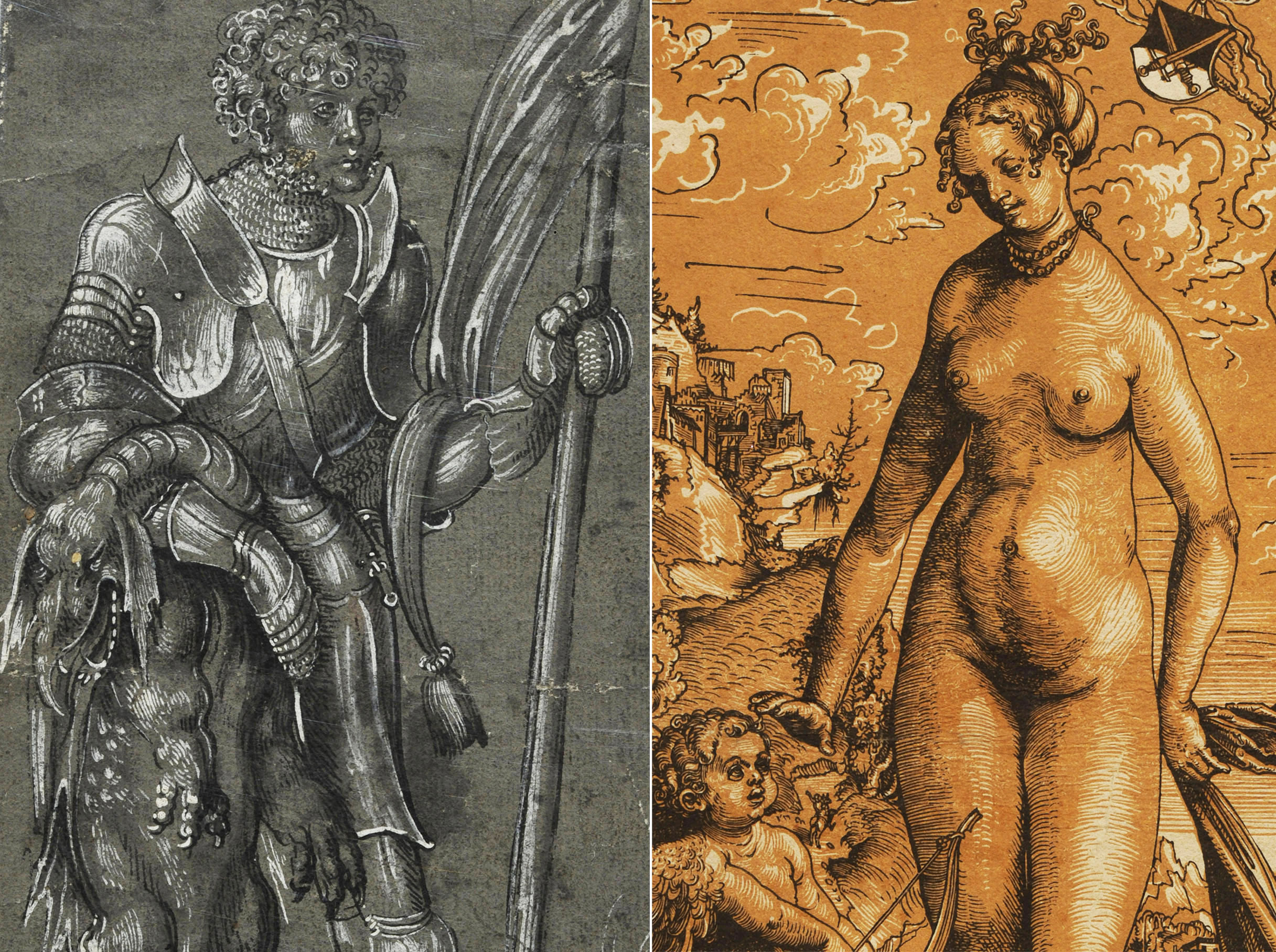
Left: Lucas Cranach the Elder, St George, about 1505, pen and brush, grey ink with highlights in white on paper with grey wash (detail), Szépmuvészeti Múzeum Budapest; Right: Lucas Cranach the Elder, Venus and Cupid, 1509, coloured print on paper (detail), Staatliche Museen zu Berlin - Preußischer Kulturbesitz, Kupferstichkabinett
From 2023 to 2026, a research project funded by the DFG and the Ernst von Siemens Kunststiftung systematically catalogued over 300 drawings and 600 prints – in their various states and editions, comprising more than 2,700 impressions - by the Cranach family. The results are freely accessible in the CDA. Spanning art history, technical studies, conservation science, and computer science, this interdisciplinary initiative has established the structural and methodological foundations for future project phases
Digitisation and cataloguing
Over the course of 36 project months, the team successfully catalogued 25 print collections in Bautzen, Dessau, Leipzig, Düsseldorf, Erlangen, Frankfurt am Main, Göttingen, Heidelberg, Hanover, Nuremberg, Wittenberg (the Luther House, the Cranach Foundation, Research Library for the History of the Reformation), Wolfenbüttel, Gotha, Basel, Bern, Weimar and Coburg (Veste Coburg Art Collections, Landesbibliothek Coburg), Braunschweig, Berlin, Paris (Louvre, Bibliothèque nationale de France) and Dresden, documenting a total of over 2,200 impressions as well as over 320 drawings and paintings on paper. This was achieved using several methods, including standardised high-resolution photography (in reflected, transmitted, and raking light), relevant metadata collection, and supplementary imaging and analytical techniques. Data records from other graphic collections (including Coburg and Vienna) were integrated. The research data was imported into the TMS backend database, where it was edited before being transferred to the CDA. In parallel, a collaborative technical examination was carried out on 35 drawings and 340 prints at the Kupferstichkabinett Berlin, alongside 31 drawings and 244 prints at the Kupferstich-Kabinett Dresden. The resulting data was then entered into the TMS backend database.
By creating over 600 work records the foundation has been laid for a level of catalogue description previously unattained, comparability of the prints and precise data structuring within the framework of a scholarly catalogue raisonné.
The foundation for a new standard in scholarly cataloguing has been laid with the creation of over 600 entries. This milestone allows for the precise comparison of prints and exact data structuring within the framework of a catalogue raisonné. By incorporating the archival materials of Armin Kunz and Dieter Koepplin, these entries consolidate collected information on Cranach’s prints, including their conditions, editions, and distinctive features. Every newly digitized and examined print is directly linked to this data. Simultaneously, this comprehensive research has uncovered considerably more project-relevant works than prior literature implied. Compared to an original estimate of 600, the total has grown to over 720. Furthermore, major collections hold more prints than previously attributed to Cranach, laying the groundwork for a follow-up project.
Technical examination
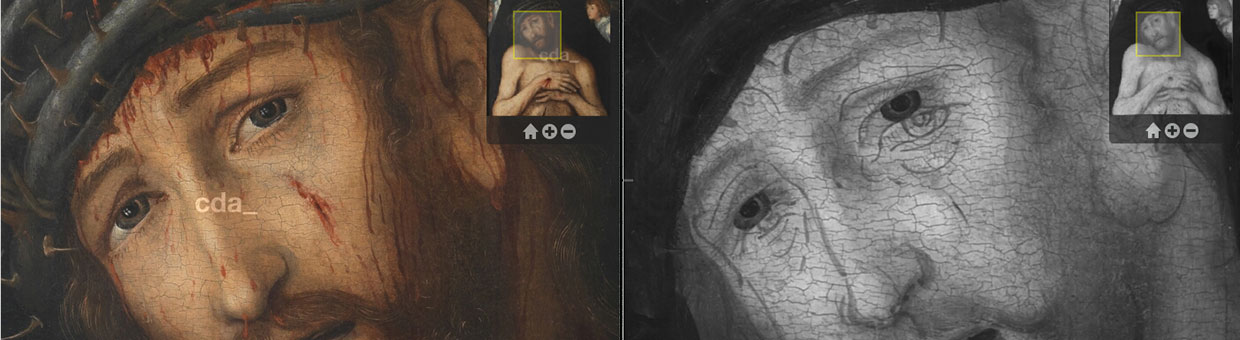
As part of the project, the Cologne team examined over 260 drawings and paintings on paper, as well as over 2,200 prints (impressions) from various collections, using light microscopy and other analytical methods. The results were documented according to defined descriptive criteria. Infrared reflectograms (IRR, 900–1700 nm) of over 250 drawings, along with multispectral images of 100 drawings using the Phase One MSI system and another 80 works using the Xatra X71 MSI system, have, for the first time, enabled the phenomenological classification of materials used, the identification of possible alterations during the creative process, and the detection of subsequent changes due to ageing or restoration. In addition, over 200 drawings and coloured prints have so far been examined using X-ray fluorescence analysis (XRF), and a further 50 works using VIS spectrometry. These methods have been systematically applied for the first time in the analysis of Cranach’s drawings and prints. The evaluation has uncovered valuable new insights, including details on dating, authenticity, and the original context of the artwork's creation. Further processing and interpretation of the research data (including watermarks and MSI) is planned as part of a follow-up project.
Development of the infrastructure
Workflows were developed, tested and adapted to ensure the smooth exchange of data between the database systems used by the partner institutions: TMS (Düsseldorf), MuseumPlus (Berlin), Daphne (Dresden) and APS (Marburg). Data fields and their content were harmonised and standardised in accordance with the LIDO application profile 'Graphics’, developed in Marburg, This approach incorporates relevant specialist terminology to enable seamless data flow across different database architectures. Using persistently referenceable controlled subject vocabularies ensures research data remains interoperable with international knowledge networks, aligning with Linked Open Data principles. Standardising cataloguing practices is a foundational measure whose value extends beyond the Cranach project.
The CDA's monolithic architecture has been successfully modernised into a microservice-oriented structure. Instead of relying on direct database imports, the system now processes XML data to generate structured JSON files that are both human- and machine-readable. These items are indexed in Elasticsearch and made available via a faceted search. The provided data is accessible to all services via a REST API, and the search interface is implemented as a standalone React application that communicates with the API. Users can filter the data according to various criteria, with the number of hits per filter displayed. The artefact pages are statically generated, which ensures significantly better performance and optimised search engine visibility, particularly for content that is rarely updated. The frontend now features a geographical map, a Web VR view, and a timeline. Users can download images of the prints using the integrated download tool. Thus, the objective set out in the proposal – a high-performance, modular and future-oriented user interface – has been achieved and further expanded.
By employing collaborative research methods from both the humanities and natural sciences, and by providing access to research data via a high-performance infrastructure, the CDA enables a deeper understanding of the works, their creation, and their significance. The technical examination of drawings, paintings, and prints, and the systematic evaluation of findings in continuous dialogue with art-historical research, are expected to yield further insights. Specifically, this approach will shed light on working processes within the Cranach workshop, attribution and dating, function and original contexts, as well as early modern publication processes and artistic exchange.
Project partners
Project partners of the research project “The graphic works of Lucas Cranach the Elder, his sons and the workshop. Digitisation, cataloguing, interdisciplinary research and the development of a networked research resource” (2023–26): Cologne University of Applied Sciences; The Kunstpalast, Düsseldorf; the Kupferstichkabinett, Staatliche Museen zu Berlin, Deutsches Dokumentationszentrum für Kunstgeschichte – Bildarchiv Foto Marburg, Philipps-Universität Marburg, and the Kupferstich-Kabinett, Staatliche Kunstsammlung Dresden, as well as numerous other collections.
Art Technological Examination of Paintings
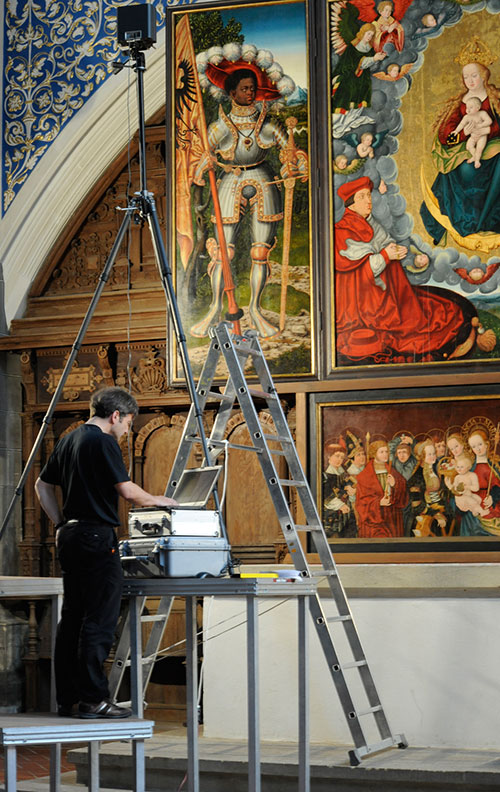
Examination of the Altarpiece of the Virgin (1529) in the Marktkirche at Halle
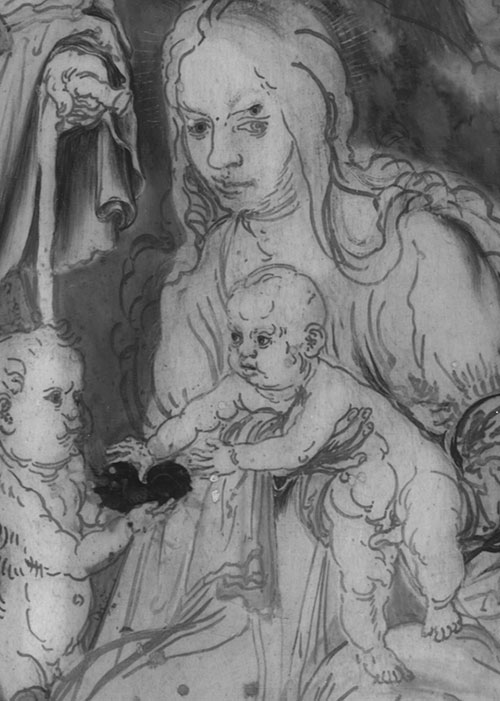
In cooperation with our partners the cda-team has examined 1139 paintings in 152 collections and churches employing new methods such as infrared reflectography, that enables the compositional design beneath the paint layers to be seen. By this means new insights were gained concerning the working process and the division of labour within the Cranach workshop. The results of the examination are freely accessible in the research archive and publications evaluating the results can be downloaded (see below).
Transcriptions from Archival Material
Numerous archival documents relating to Lucas Cranach the Elder in the Ernestine Archive were digitalized for the first time for the Cranach Digital Archive in cooperation with the Central State Archive of Thuringia, Weimar and transcribed anew by Monika and Dieter Lücke. At present receipts from account books (40 files with c. 100 pages of archival material) listing invoices for material and contract work, including the work for the castle of Torgau, various letters and the ‘Turkish tax’ tax register for the town of Wittenberg have been published online.
Documents from the city archive in Kronach recording the court case against the Cranach family have for the first time been completely processed and published.
At present about 1,000 receipts from the city archive of Wittenberg (up to 1550) are being processed, as well as the archive of St. Maria, the parish church of Wittenberg. To complement this, further documents in the Thuringia Central Archive in Weimar will be accessed, as well as documents in the State archives of Dresden, Schwerin and Magdeburg.
The network of trade and travel routes used by Cranach the Elder
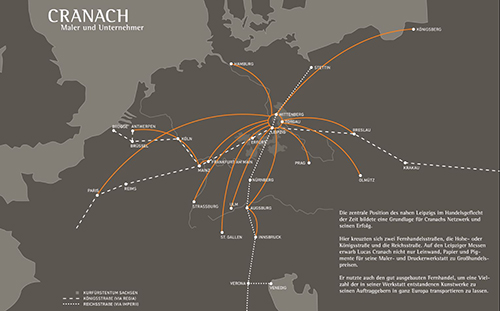
Screenshot of animation
For the exhibition 'Cranach. Meister - Marke - Moderne' (Museum Kunstpalast, Düsseldorf 8 April - 30 July 2017) the Cranach Digital Archive created an animated presentation, illustrating the extensive network of trade and travel routes used by Lucas Cranach the Elder.
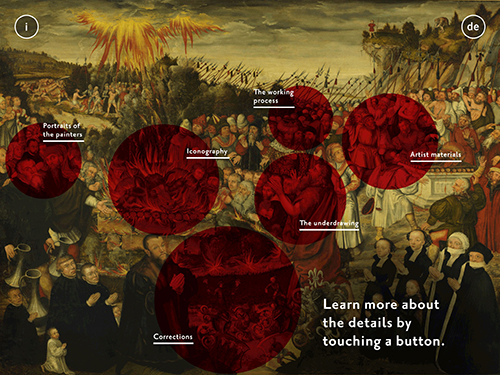
The Sacrifice of Elijah
Screenshot of presentation
In 2015 the Cranach Digital Archive was one of the cooperation partners for the exhibition "Lucas Cranach der Jüngere. Entdeckung eines Meisters“ in Wittenberg and for this context prepared a presentation, which includes the research results concerning the painting "The Sacrifice of Elijah", owned by the Stadtgeschichtliche Museum Leipzig (to painting).
It was lent to the exhibition (26 June - 1 Nov 2015) and is now on display in the Stadtgeschichtliche Museum Leipzig.
Publications
Lucas Cranach the Elder, Holy Family (Rest on the Flight into Egypt), 1504. Detail Staatliche Museen zu Berlin, Preußischer Kulturbesitz, Gemäldegalerie. Detail: Maria and child, infrared reflectogram
Since the beginning of the project (2009) the cda-team has also contributed to numerous printed scholarly publications:
Görres, D., Klinke, T., Martin Luther als „Junker Jörg“. Zur Entstehung und den Auflagen eines Holzschnitts Lucas Cranachs des Älteren, In: W. Greiling, U. Schirmer, E.A. Werner (eds.) Luther auf der Wartburg 1521/1522. Bibelübersetzung – Bibeldruck – Wirkungsgeschichte (Quellen und Forschungen zu Thüringen im Zeitalter der Reformation 13), Cologne 2023, 297–320.
Heydenreich, G., Görres, D, Wismer, B. (eds.) Lucas Cranach der Ältere: Meister – Marke – Moderne, exhibition catalogue Museum Kunstpalast, Düsseldorf. Munich (2017).
Heydenreich, G., Die Veränderungen des Zwickauer Cranach-Retabels im Entstehungsprozess – Ergebnisse strahlendiagnostischer Untersuchungen. In: T. Pöpper (ed.) Cranach in Zwickau. Das Retabel in der St. Katharinenkirche, Regensburg (2017) 111–120.
Heydenreich, G., Görres, D., Herrschaft, J., Die Werkstatt Cranachs des Jüngeren. In: R. Enke, K. Schneider, J. Strehle (eds.) Lucas Cranach der Jüngere. Entdeckung eines Meisters, Munich (2015) 64-77.
Werner E.A., Eusterschulte A., Heydenreich G. (eds.) Lucas Cranach der Jüngere und die Reformation der Bilder. Munich (2015).
Lücke, M., Lucas Cranach d. J. als Unternehmer. In: E.A. Werner, A. Eusterschulte, G. Heydenreich (eds.) Lucas Cranach der Jüngere und die Reformation der Bilder. Munich (2015) 30-41.
Lücke, D., Die Cranach-Familie in den Grumbach'schen Händeln. In: E.A. Werner, A. Eusterschulte, G. Heydenreich (eds.) Lucas Cranach der Jüngere und die Reformation der Bilder. Munich (2015) 52‒61.
Görres, D., Cranach, Luther und die Ernestiner. Der Epitaphaltar der Stadtkirche St. Peter
und Paul in Weimar. In: F. Bomski, H. Th. Seemann, Th. Valk (eds.) Bild und Bekenntnis. Die Cranach-Werkstatt in Weimar (Jahrbuch der Klassik Stiftung Weimar), Göttingen (2015) 37-53.
Heydenreich, G., Sandner, I., Smith-Contini, H., Der Streit um die Autorschaft. Das Weimarer Cranach-Retabel im Lichte technologischer Untersuchungen. In: F. Bomski, H. Th. Seemann, Th. Valk (eds.) Bild und Bekenntnis. Die Cranach-Werkstatt in Weimar (Jahrbuch der Klassik Stiftung Weimar), Göttingen (2015) 193-204.
Herrschaft, J., Heydenreich, G., A Lucretia by Lucas Cranach the Elder at the Bilbao Fine Arts Museum. In: Bulletin of the Bilbao Fine Arts Museum 8 (2014) 15-39.
Heydenreich, G., The Cranach Digital Archive: challenges and perspectives for interdisciplinary research in digital transformation. In: Smolnik, R. (ed.) CIDOC 2014. Annual Conference. Access and Understanding – Networking in the Digital Era, 6th – 11th September 2014, Dresden (2014) 47.
Heydenreich, G., Das Cranach Digital Archive – eine Ressource für interdisziplinäre Forschung. In: A. Bienert, F. Weckend, J. Hemsley (eds.) Konferenzband: EVA2013 Berlin. Elektronische Medien & Kunst, Kultur, Historie. 6.-8. November 2013, Berlin (2013) 43-48.
Heydenreich, G., The Cranach Digital Archive: Challenges and Perspectives for Collaborative Art Technological and Art Historical Research, In: Postprints of the 33rd Congress of the International Committee of the History of Art (CHIA2012), 15th – 20th July 2012, Nuremberg (2013).
Heydenreich, G., Beobachtungen zum Werkprozess. In: Pöpper, T. (ed.) Das Schneeberger Reformationsretabel von Lucas Cranach dem Älteren. Altenburg (2013) 108-117.
Heydenreich, G., Reisende Bilder im Wandel. In: G. Messling (ed.) Die Welt des Lucas Cranach. Ein Künstler im Zeitalter von Dürer, Tizian und Metsys , exhibition catalogue, Brussels (2010) 66‒79.
(a more detailed list of publications by the authors is available in the bibliographical database)